
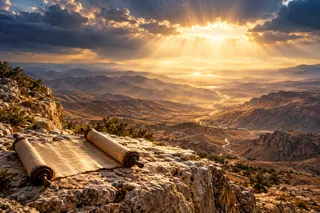
On Simchat Torah we reach the final words of the Five Books of the Torah. Moshe blesses the tribes of Israel, climbs Mount Nebo, sees the land from a distance, and dies. It seems that the story has reached its end. Yet the closing verses do not sound like a door being shut. They leave an expectation behind:
“No prophet has risen again in Israel like Moshe, whom the LORD knew face to face.”
Deuteronomy 34:10
If no prophet like Moshe had yet arisen, is the Torah only summing up the past, or is it leaving room for someone still to come? And who is the figure hidden among Joseph’s blessing, the life of Moshe, and the LORD riding the heavens to help Israel?
Two books that end with blessing and death
Genesis and Deuteronomy end in a similar way. Near the end of Genesis, Jacob blesses the tribes of Israel and dies. Near the end of Deuteronomy, Moshe blesses the tribes and dies. In both cases the blessing looks beyond the life of the one who gives it, toward the future of the people.
But there is another connection. Genesis closes with Joseph. His brothers rejected him, sold him into Egypt, and were certain that he was lost. There, far from his father’s house, he was brought low and then lifted up. When famine came, the rejected brother became the one who held bread and life in his hands. His brothers stood before him without recognizing him, until Joseph himself revealed his identity and said, “I am Joseph.”
Joseph could have taken revenge, but he chose to forgive, provide, and save. Even his death does not close the story. His final words are a promise: “God will surely visit you.” He looks ahead to the Exodus before it can yet be seen on the horizon.
Could it be that at the heart of the greatest redemption there will again stand a brother who was rejected, hidden from his brothers’ eyes, and finally revealed to them as their savior?
Joseph: the shepherd, the stone, and the unrecognized brother
When Jacob blesses Joseph, he calls him “the shepherd, the stone of Israel.” The expression can describe Joseph as the one who became the support and provider of the house of Israel. We do not need to turn every word here into an explicit prophecy about Messiah in order to see the pattern: the suffering brother becomes the shepherd, support, and rescuer of the family that rejected him.
Joseph also receives a prominent place in Moshe’s blessing. “His firstborn bull has majesty” is not a description of a sacrifice, but of splendor, strength, and rank. His horns push peoples, and the blessing of the land rests upon his head. Joseph remains a picture of strength born out of humiliation, and of life coming through the one his brothers did not at first recognize.
Moshe: the redeemer who leaves a question behind
If Joseph presents the rejected brother who becomes a savior, Moshe presents the redeemer and mediator. He stands before Pharaoh, leads Israel out of slavery, brings the people through the sea, climbs the mountain, and brings the word of the LORD. When Israel sins, Moshe does not turn away. He stands in the breach and asks for mercy.
Yet Moshe himself had already said that the story would not end with him: “The LORD your God will raise up for you a prophet like me from among you, from your brothers. You shall listen to him” (Deuteronomy 18:15). At the close of the Torah, Joshua is ready to lead the people into the land, but the text still says that no prophet like Moshe had arisen in Israel. Joshua is a faithful successor, but the expectation of the prophet like Moshe remains open.
Who can be a brother from within Israel like Joseph, a prophet and redeemer like Moshe, and yet bring a redemption greater than the one Moshe led?
The One who comes from Sinai and rides the heavens
Before Moshe blesses each tribe individually, he opens with a far greater picture:
“The LORD came from Sinai and dawned from Seir upon them; he shone forth from Mount Paran and came from myriads of holiness. At his right hand was fiery law for them.”
Deuteronomy 33:2
In its first sense, this remembers the revelation at Sinai. The LORD came to his people, dawned, shone forth, and myriads of holy ones were with him. But biblical poetry does not leave the event behind as an object in a museum. The Hebrew word ba can also sound like living movement: he comes. The past becomes a pattern. The One who came from Sinai is the One who can come again.
The case does not rest on a single word. Near the end of the blessing, Moshe returns to the same figure and declares:
“There is none like the God of Yeshurun, who rides the heavens to your help, and the skies in his majesty.”
Deuteronomy 33:26
The parasha begins with the LORD coming with myriads of holy ones and ends with the LORD riding the heavens to help Israel. He does not come to replace his people, but to help them, save them, and bring them into the rest he promised.
The phrase “myriads of holiness” is also wider than we sometimes allow it to be. The text does not say only “angels” here. It presents the King surrounded by his holy company. As the Scriptures unfold, the picture will include the armies of heaven, his angels, and the holy ones who belong to him. We need not reduce that company to one group when the Bible itself opens the picture gradually.
Habakkuk hears the footsteps of redemption again
Centuries later, Habakkuk returns to the same southern route, to Teman and Paran. He is not content with a story about what the LORD once did. He prays, “LORD, revive your work in the midst of the years.” Do it again. Bring your work to life within our years.
“God comes from Teman, and the Holy One from Mount Paran. His glory covers the heavens, and his praise fills the earth. His brightness is like the light; rays flash from his hand, and there his power is hidden.”
Habakkuk 3:3–4
The same places return, but this time the text says plainly, “he will come.” His splendor covers the heavens, brightness like light shines from him, and rays of light come from his hand. He then rides on chariots of salvation, treads through the sea, and goes out “for the salvation of your people, for the salvation of your anointed.”
Habakkuk takes the language of Sinai and the Exodus and directs it toward a salvation still needed. The future redemption will not be a different story cut off from the past. It will be a greater Exodus: the same God, the same covenant people, the same faithfulness, but this time the rescue will reach its fullness.
The LORD comes from Sinai with myriads of holy ones.
He rides the heavens to help Israel.
Habakkuk sees him coming again from Paran, full of light and power.
He goes out to save his people and his anointed.
Why is the future salvation described in words that so strongly recall Sinai and the Exodus, unless we are meant to understand that the One who came in the first redemption is also the One who will complete the redemption?
A Son of Man who comes with the clouds of heaven
Daniel adds a surprising detail to the picture. In his vision he sees “one like a son of man,” a human figure coming with the clouds of heaven and approaching the Ancient of Days. He is given everlasting dominion, glory, and a kingdom, and all peoples and languages serve him (Daniel 7:13–14).
On the one hand, he is a son of man, a human figure. On the other, he comes with the clouds, an image the Bible associates with the sovereignty of the God of Israel. He is not merely another king in a succession of kingdoms. His kingdom does not pass away, and his dominion is not destroyed.
Now the questions begin to converge. Who is the brother from Israel whom his brothers did not recognize? Who is the prophet like Moshe? Who is the Son of Man who receives an everlasting kingdom? And who is the One whose return is described as the coming of the LORD with his holy ones and as riding upon the clouds of heaven?
The hidden One begins to be revealed
Yeshua spoke of himself as Daniel’s Son of Man. Before the high priest, he said that they would see the Son of Man seated at the right hand of Power and coming with the clouds of heaven. When he taught about his return, he said that the Son of Man would come in his glory with his angels and then sit on his glorious throne.
The question is not merely whether Yeshua resembles Joseph or Moshe. He did come as a brother from within Israel. Like Joseph, he was rejected by his brothers, handed over to the nations, humbled, and finally became a source of life for many. Like Moshe, he teaches the word of the LORD, stands as mediator, and leads into freedom. But in the description of his return, he does not appear only as another prophet. He comes in the image of the One who rides the heavens.
The One hidden within Moshe’s blessing is the Redeemer toward whom all the patterns lead: the rejected brother like Joseph, the prophet greater than Moshe, Daniel’s Son of Man, and the rider of the heavens who comes with his holy ones to help Israel. In Yeshua the Messiah, these lines meet.
Zechariah says, “The LORD my God will come, and all the holy ones with you.” The New Covenant Scriptures describe Yeshua returning with his angels and with the armies of heaven. They also speak of his coming with all his holy ones. Therefore the myriads of holiness should not be reduced to angels alone. The complete picture is of the King coming with heaven’s company and with those who have been redeemed and belong to him.
At his first coming, he was like Joseph before the moment of revelation: present, near, and yet unrecognized by his brothers. When he comes again, the concealment will be removed. This is not the abandonment of Israel or the replacement of the covenant. He comes to help Yeshurun, to save his people, and to bring the redemption of which the Exodus from Egypt was only the beginning.
A redemption that also passes through the heart
The hope of Messiah’s return does not leave us only with a chart of the future. The same Redeemer who will lead his people into complete freedom is already at work in the person who turns to him. He brings us out of slavery to sin, fear, and shame, gives a new heart, and leads us to learn the ways of the LORD from within.
Inner redemption does not replace the redemption of Israel or turn the national promises into a mere parable. It is an early taste of the same kingdom. The King who will one day set the world right already begins by restoring hearts. The One who will lead a greater Exodus invites us now to leave everything that holds us in slavery and to lean upon him.
The ending that brings us back to the beginning
On Simchat Torah we do not remain for long beside Moshe’s hidden grave. Immediately after the final verses of Deuteronomy, we return to the first words: “In the beginning, God created.” The Torah ends and begins again in the same breath.
There is more here than a reading cycle. The first creation itself waits for completion. The first Exodus points toward a greater redemption. Joseph points toward the brother who will be revealed. Moshe points toward the prophet who will arise. And the rider of the heavens still promises to come to the help of his people.
The Torah ends, but the promise remains open. And in the center of that hope stands Yeshua: the brother, the prophet, the Son of Man, and the coming King.
Think and discover
Questions for reflection
- What shared lines do you see between Joseph, Moshe, and Yeshua?
- Why does the Torah end by saying that no prophet like Moshe had yet arisen?
- What does Habakkuk add to the picture of the LORD coming from Sinai and riding the heavens to help Israel?
- What is revealed about the identity of the Son of Man when Daniel is connected with Yeshua’s words about his return?
- From what inner slavery do you need the Redeemer to bring you out even today?
Prayer
God of Abraham, Isaac, and Jacob
Thank you for the Torah, for your covenant, and for the redemption you have already accomplished for your people. Open our eyes to see the path that runs from Joseph to Moshe, from Sinai to the prophets, and from the prophets to Yeshua the Messiah. Bring us out of every inner slavery, teach us to listen to your voice, and to lean upon the Redeemer you have given. Guard the people of Israel, reveal your face to us, and come with your holy ones to complete the salvation you promised. Amen.
Scripture excerpts are translated from this site’s Hebrew text. Full-reading links open the Complete Jewish Bible, which follows Hebrew verse numbering.