
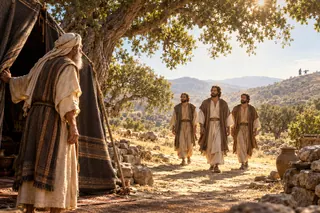
The portion opens with a sentence we cannot pass over quickly: “Adonai appeared to him by the oaks of Mamre.” Adonai appeared to Abraham. But in the very next verse Abraham lifts his eyes and sees three men. He runs to meet them, bows, brings them into the tent, and serves them a meal. For a moment this seems like a simple story of hospitality. Then one of them promises that Sarah will bear a son, the text again calls the speaker “Adonai,” and two of the men continue to Sodom as angels.
Who exactly appeared to Abraham? Why does the Torah move between “men,” “angels,” and “Adonai”? And why does the same portion end at Moriah, where the Angel of Adonai calls from heaven and speaks in God’s own voice?
Parashat Vayera does not give us a neat diagram. It invites us to draw close, look again, and let the tension remain until the whole story opens. Along the way it joins revelation to hospitality, promise to laughter, judgment to mercy, and a son born by a miracle to a son received back as though from the dead.
Adonai appears, and Abraham sees three men
Jewish tradition noticed the difficulty in this opening long ago. Rashi reads the first verse as the Holy One visiting Abraham after his circumcision, and the three men as angels who each came for a different mission. Rashbam makes a more direct connection: How did Adonai appear to him? Three men, who were angels, came to him. Genesis Rabbah also preserves a picture in which Abraham saw the Shekhinah and saw the angels.
The interpretations differ, but they agree on something central: the opening concerns a real divine revelation. This is not merely a chance meeting with travelers. The text itself says that Adonai appeared, and then leaves us asking how his presence relates to the visitors who can be seen.
The rest of the story keeps the mystery alive. One visitor says, “I will surely return to you at this season next year, and behold, Sarah your wife will have a son.” A few verses later Adonai himself says, “At the appointed time I will return to you.” Then the men rise and walk toward Sodom, while Abraham remains standing before Adonai. In the next chapter, only two angels arrive in Sodom.
Did Abraham see Adonai separately from the three, through the three, or in the form of one of them? The Torah does not close the question, but neither does it allow us to ignore it.
A God who visits, and a man who opens his tent
The great mystery appears inside a very ordinary act. Abraham sits at the entrance of the tent in the heat of the day. When he sees the guests, he runs, brings water, bread, curds, milk, and a calf, and stands beside them while they eat. The sages learned from the opening that the Holy One visits the sick, and from Abraham’s actions how great hospitality is.
The portion does not separate seeking God’s presence from the way we treat the person standing at the entrance. Abraham does not yet know the full identity of his guests, yet he makes room for them. Sometimes revelation comes not when we try to escape the world, but when we set a table, give water, and truly see the person before us.
The letter to the Hebrews echoes the story when it says not to forget hospitality, because some have hosted angels without knowing it. This is not a promise that every guest is an angel. It is an invitation to live humbly: we may not yet understand the full meaning of the person or moment God has placed in our path.
“Is anything too wonderful for Adonai?”
Inside the tent Sarah hears that she will bear a son and laughs within herself. Her body and the length of the years tell one story, while the promise tells another. Adonai does not shame her pain or ignore reality. He asks a question that runs through the whole portion: “Is anything too wonderful for Adonai?” Is anything too difficult or too far beyond reach for him?
“At the appointed time I will return to you, at this season next year, and Sarah will have a son.”
Genesis 18:14
The son is named Isaac, Yitzchak. The laughter of impossibility becomes the laughter of wonder, and everyone who hears laughs with Sarah. Yet the Torah does not turn Isaac’s choosing into indifference toward Ishmael. When Hagar and her son wander in the wilderness, God hears the boy’s voice, opens her eyes to a well, and promises to make a nation of him too. The promised son is chosen to carry the covenant line, while the other son is still seen, heard, and preserved before God.
Righteousness and justice against the way of Sodom
Adonai does not reveal the matter of Sodom to Abraham merely to give him information about the future. He recalls Abraham’s calling: to command his children and household to “keep the way of Adonai by doing righteousness and justice.” Abraham was chosen to become a family and a people through whom blessing would come, so he stands before Adonai and seeks mercy even for a corrupt city.
Sodom represents the opposite. Ezekiel describes its sin as pride, abundance, and ease that did not strengthen the hand of the poor and needy. In the portion itself, the mob seeks to crush the guests and the one protecting them. In place of an open tent stands a besieged door; in place of righteousness and justice stands power that turns the stranger into an object.
Abraham draws near and argues: “Shall the Judge of all the earth not do justice?” This is not rebellion against God, but trust in his character. Abraham asks that judgment be just and that even a few righteous people be taken into account. The portion teaches that hatred of evil need not extinguish mercy toward human beings.
The same Lech Lecha, toward a mountain not yet seen
Near the end of the portion, God again calls Abraham to go: “Lech lecha, go to the land of Moriah.” The first call took him from his land toward a promise he could not see. The second touches the most precious thing he received within the promise: “your son, your only one, whom you love, Isaac.”
The Torah does not present child sacrifice as an ideal. The story reaches its climax precisely when Abraham is stopped and the young man lives. But the road to Moriah reveals profound trust. Abraham told his servants, “We will worship and we will return to you,” in the plural. The letter to the Hebrews explains that he reasoned God was able even to raise Isaac from the dead, and figuratively he did receive him back.
This trust did not arise in a single moment. Abraham had already seen God give life where the body had no strength left, and preserve the covenant promise even when Abraham himself failed and placed it in danger in Abimelech’s house. Moriah therefore presses the question to its furthest point: Can the One who promised Isaac keep his word even beyond death?
Isaac carries the wood and asks, “Where is the lamb for the burnt offering?” Abraham answers, “God will see to the lamb for the burnt offering, my son.” That day a ram is found in the thicket and becomes Isaac’s substitute. Abraham names the place “Adonai Yireh.” In Hebrew, seeing and providing meet here: God sees the need, provides the offering, and on the mountain of Adonai he is also seen and revealed.
Who speaks from heaven?
As Abraham reaches out his hand, the “Angel of Adonai” calls to him from heaven. But notice how the messenger speaks: “Now I know that you fear God, since you have not withheld your son, your only one, from me.” Not “from him,” but “from me.”
When the angel calls a second time, he continues: “By myself I have sworn, declares Adonai,” and then renews the blessing of the seed and the nations. Several Jewish commentators and biblical scholars have noticed that the boundary between the messenger of Adonai and Adonai himself becomes very thin here. Rabbeinu Bahya, for example, explained that this is not a simple, separate messenger, but a manifestation in which God’s presence acts and speaks.
The portion began with “Adonai appeared to him” and ends with “on the mountain of Adonai he will be seen.” Is the story concerned not only with what God provides, but with the identity of the One through whom God is seen?
The Haftarah: the son who was given, died, and returned to his mother
The Haftarah brings us back to the same sounds. The Shunammite woman opens her home to Elisha, as Abraham opened his tent. She has no child, and the prophet promises her, “At this season next year, you will embrace a son.” This is the same Hebrew expression spoken to Sarah, ka’et chayah, “at the time of life.” Scripture thus binds the two stories together: where human strength cannot bring forth life, God gives a son and keeps his word.
Then the story goes further. The boy dies on his mother’s knees. The promise she received appears to have collapsed, but she lays him in the man of God’s room and goes to find Elisha. He enters, shuts the door, and prays to Adonai. Warmth returns to the body, the child opens his eyes, and the prophet tells the mother, “Pick up your son.”
“She came and fell at his feet and bowed to the ground. Then she picked up her son and went out.”
2 Kings 4:37
The connection to the portion is not only that two women without children received a son. Sarah receives Isaac by a miracle, Abraham goes with him toward the place of death, and receives him back. The Shunammite receives a son by a miracle, loses him, and truly receives him back. Torah and Prophets together raise a greater question: Can God’s faithfulness pass even through death?
Abraham saw his day and rejoiced
Here the apostolic writings dare to read all the lines together. Yeshua says, “Abraham your father rejoiced to see my day; he saw it and was glad.” When his hearers ask how he could have seen Abraham, he answers, “Before Abraham was, I am.”
The apostolic writings do not explicitly say that the third man at the oaks of Mamre was Yeshua. We should not claim more than is written. But they do say that the unique Son, close to the Father’s heart, has made God known; and that the Word who was with God and was God became flesh and dwelt among us. The Messianic reading therefore does not insert a foreign figure into the portion. It asks whether the One through whom God makes himself seen throughout the story is the same Word of God who was revealed fully in Yeshua.
The hidden One begins to be revealed: Yeshua is the son of Abraham and the promised Son greater than Isaac. He reveals the Father, willingly carries the wood of his offering, and receives no substitute in his place. God “did not spare his own Son, but gave him up for us all.” He died, rose from the dead, and will never die again. In him the Haftarah’s question receives its answer: God’s faithfulness does not stop at the grave.
Isaac remains Isaac, the covenant son from whom Israel was born; we do not need to erase the story in order to see the Messiah. On the contrary, Yeshua enters the depth of Israel’s story. He is the seed in whom the families of the earth are blessed, the lamb God provided, and the Son who truly rose from the dead. What appeared at Moriah as a pattern and at Shunem as a temporary miracle becomes in him the beginning of a resurrection that does not return to the grave.
A Vayera that also begins within us
Redemption in this portion is not merely information about the identity of the mysterious guest. It asks which door we open. Do we live like Abraham, who sees a person, runs to meet him, and does righteousness and justice, or like Sodom, which uses power and keeps abundance for itself? Are we ready to pray even for those far from us, and not only for our own circle?
The Spirit of God already works that inward redemption in us. He opens our eyes to the well we had not seen, softens the heart toward the stranger and the poor, releases our grip on what we fear losing, and teaches us to trust God where promise and reality appear to contradict. Faith in resurrection is not an escape from pain. It is a refusal to give death the final word.
Yet as in every portion, inward redemption is not the end of the road. Israel still waits for the fullness of the promises, the nations still need blessing, and creation still groans. Yeshua who rose will return as the Judge of righteousness and the King of mercy. The dead will rise, injustice will be stopped, and the blessing Adonai swore to Abraham will reach its fullness in the land and among all the families.
Adonai appears to Abraham, and his presence is hidden within a visit from guests.
The promised son is born where no human strength remains to give birth.
At Moriah the son is received back, and in the Haftarah a dead son returns to life.
In Yeshua, the Son who rose and dies no more, revelation and resurrection reach their center.
The portion does not leave us only with the question, “Who were the three men?” It invites a deeper question: Will we recognize God when he draws near in a way we did not expect, and will we trust him when the road to the promise passes through a place that looks like the end? At the oaks of Mamre he appeared; at Moriah he saw and provided; in Yeshua he was revealed and rose. Therefore, even where we do not yet see the answer, we can say: Adonai sees, Adonai is faithful, and death is not the final word.
Think and discover
Questions for reflection
- What in the text of Genesis 18 raises the question of who appeared to Abraham?
- How is Abraham’s hospitality connected to the righteousness and justice his household is called to practice?
- What do Sarah, Hagar, and the Shunammite teach us about the God who sees, hears, and gives life?
- Why does the Angel of Adonai at Moriah speak in God’s own voice?
- How does the Haftarah deepen the Akedah and the hope of resurrection?
- What becomes clearer when we read Yeshua’s words, “Abraham saw my day,” in light of the portion?
One small step this week
Open a door and carry a prayer
Slowly read Genesis 18:1–33 and 2 Kings 4:18–37. Think of one person you find easy not to see, and one situation for which you have stopped praying. This week, take one step of hospitality, righteousness, or listening, and bring that situation before God again. Share this question with someone else: What changes when we believe that death is not the final word?
God of Abraham, Isaac, and Jacob, you see, hear, and keep your word. Open our eyes to recognize your presence and the people you bring to the entrance of our lives. Form righteousness and justice in us, give us a heart that seeks mercy, and faith that does not run away when the road is hard. Reveal Yeshua to us, the beloved Son who rose from the dead. Comfort your people Israel, bring blessing to the nations, and make us alive in the hope of the day when death will be swallowed up forever. Amen.
Scripture excerpts are translated from this site’s Hebrew text. Full-reading links open the Complete Jewish Bible, which follows Hebrew verse numbering.