
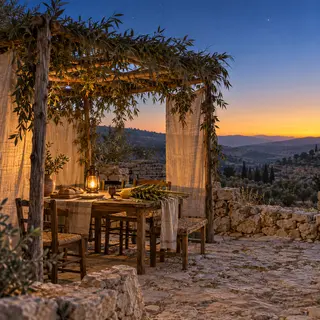
Only a few days after Yom Kippur, we step outside again. We have barely finished fasting, confessing, and asking for mercy, and already we are carrying boards, branches, and decorations, building a place for joy.
What kind of joy can remain when the walls are thin and life is not in our hands?
It is a strange kind of joy. It does not take place behind thick walls, but beneath a roof through which we can see the stars. The wind enters, and sometimes the rain does too. The sukkah will not let us pretend that everything is permanent and under our control. Yet it is precisely about this festival that the Torah says:
“You shall rejoice before the LORD your God seven days.”
Leviticus 23:40
The joy that follows Yom Kippur
Sukkot does not come before Yom Kippur, but after it. First come self-examination, judgment, atonement, and cleansing; only then does the Torah command us to enter the sukkah and rejoice. On Yom Kippur we hear, “Before the LORD you shall be clean.” Jewish tradition also carries the imagery of the Day of Judgment, when the verdict is sealed.
In a Messianic reading, this order also points forward: toward the day when God’s judgment is revealed, Israel looks toward her Messiah and returns to Him, and atonement and cleansing reach their fullness. Sukkot shows us what lies beyond judgment and atonement: not distance, but God’s dwelling presence; not unending mourning, but bridal joy; not a world abandoned to its brokenness, but the King dwelling with His people in a renewed creation.
Awakening and self-examination
Judgment, atonement, and cleansing
Sukkah, joy, and God’s dwelling presence
The joy of Sukkot is therefore not happiness that ignores sin or judgment. It is the joy found on the other side of reconciliation. The Bridegroom does not merely overlook the broken covenant; He atones, cleanses, restores, and brings the bride beneath the chuppah.
Not a joy that ignores our frailty
The Torah gives Sukkot several faces. It is Chag HaSukkot, remembering how the Holy One caused the children of Israel to dwell when He brought them out of Egypt. It is also Chag HaAsif, the Feast of Ingathering, a time to give thanks for the gathered harvest. In Jewish tradition it is z’man simchateinu, the season of our rejoicing.
These names belong together. We gather the fruit of the land, yet leave the permanent house. We give thanks for what we have, yet remember that we do not hold life in our hands. The joy of Sukkot does not deny frailty. It is joy born within frailty because the Holy One remains faithful.
“Lord, You have been our dwelling place in every generation.”
Psalm 90:1
Israel’s surest dwelling in the wilderness was not cloth, wood, or stone. The dwelling place was God Himself. Earlier, God had described the Exodus this way: “I brought you to Myself.” He did not only bring us out of one place and into another; He brought us to Himself.
From the wilderness to the chuppah
The prophet Jeremiah remembers the wilderness journey in the language of love and betrothal:
“I remember the devotion of your youth, your love as a bride, how you followed Me in the wilderness, in a land not sown.”
Jeremiah 2:2
Jewish thought has often compared Sinai to a marriage covenant: the people stand together before God, hear the words of the covenant, and answer, “All that the LORD has spoken we will do.”Above them is the cloud of glory—a covering of presence, protection, and nearness. The connection between sukkah and chuppah is therefore more than a beautiful play of images. Isaiah himself describes Zion’s redemption this way:
“Over all the glory there will be a canopy. There will be a sukkah for shade by day… a refuge and shelter.”
Isaiah 4:5–6
But the love story was wounded. Israel turned away, and Scripture does not conceal the fracture. Yet the Bridegroom does not abandon His bride. Through Hosea He promises to draw her once more and speak to her heart:
“Behold, I will allure her, bring her into the wilderness, and speak to her heart… I will betroth you to Me forever; I will betroth you to Me in righteousness and justice, in chesed and compassion.”
Hosea 2:14, 19
Sukkot therefore looks in both directions. It looks back to the first redemption, to Israel’s bridal days in the wilderness and the clouds of glory. And it looks ahead to the day when that chesed completes its work, Messiah the King reigns, Jerusalem rejoices, and God dwells with humanity.
Yet both redemptions also address us now. Future redemption is not only a distant event that will happen outside us one day. It begins when the Holy One speaks again to the heart, when wounded trust begins to be rebuilt, when the Ruach HaKodesh causes living water to flow where we were dry, and when His grace and beauty cover our shame and renew us from within. The reign of Messiah that will one day be revealed to every eye begins even now when we allow Him to reign within us.
“Who is this coming up from the wilderness, leaning on her beloved?”
Song of Songs 8:5
The bride does not emerge from the wilderness by her own strength. She comes out leaning on her beloved. This is also what inward redemption looks like: not a life without thirst, weakness, or a long road, but a life learning on whom to lean and from whom to draw.
Joy that makes room for another
“You shall rejoice in your festival—you, your son and daughter, your male and female servant, the Levite, the stranger, the fatherless, and the widow within your gates.”
Deuteronomy 16:14
Joy is incomplete when it remains inside our comfortable circle. The Torah names those who can easily be left outside: the stranger, the orphan, and the widow—those without an inheritance, a strong family, or a table of their own.
Perhaps that is part of what makes an open sukkah so beautiful. It is not a private fortress. It is a temporary table that can be extended, with room for one more chair. Chesed at Sukkot is not an addition to joy; it is one of the ways joy becomes real.
Water we cannot manufacture
In the Land of Israel, Sukkot comes at the end of the ingathering and the threshold of the rainy season. The produce has been gathered, but the coming year still depends on water from heaven. We can plow and sow, but we cannot command the clouds.
During the Temple period, a water service became part of the festival, though it is not explicitly commanded in the Torah. The Mishnah describes the water libation at the altar and the Simchat Beit HaShoevah. The celebration was so great that the sages said, “Whoever has not seen the rejoicing at the place of water drawing has never seen rejoicing in his life.”
“With joy you will draw water from the wells of salvation.”
Isaiah 12:3
Notice the order. Joy does not come because there is no thirst, but because there is a well from which we can draw. The joy of Sukkot does not say, “I need nothing.” It says, “I know where to turn with my thirst.”
Isaiah speaks of “the wells of salvation”—ma’ayanei ha-yeshuah. The Hebrew word yeshuah, salvation, is not identical to the name Yeshua, but they grow from the same Hebrew root, and a Hebrew ear immediately hears the resonance. When Yeshua stands during the festival and calls the thirsty to come to Him, that echo gains special depth: could the wells of salvation be more than an idea—God’s gift meeting us in the Mashiach?
Light in the night
The Mishnah also remembers great lamps kindled in the Court of the Women during the rejoicing. It says that there was no courtyard in Jerusalem that was not lit by their light. Again, this is an ancient Temple tradition, not an explicit commandment in the Torah.
Yet anyone who knows Israel’s story can hardly avoid remembering the fire that gave light to the people at night, the Shekhinah that accompanied Israel in the wilderness, and the promise that darkness will not have the final word. Zechariah speaks of a day when “at evening time there will be light,” when living waters flow from Jerusalem, and when the LORD is King over all the earth.
Then comes something remarkable: the survivors from the nations go up year after year to Jerusalem to worship the King and celebrate Sukkot. The nations do not erase Israel or take Jerusalem’s place. They come to Israel’s King, to the city He chose, and learn to worship Him together with His people. This is not replacement but joining.
When thirst meets Yeshua
Against this background, Yochanan tells us that Yeshua went up to Jerusalem for Sukkot and taught in the Temple. He did not stand outside Israel’s story or offer a different festival. He entered the festival, the Scriptures, and the hope already living in the heart of the people.
Nor is this the first time in Yochanan that Yeshua speaks about living water. At Jacob’s well He meets a Samaritan woman and offers her water that will become within her “a spring of water welling up to eternal life.” Their conversation touches the dispute over Mount Gerizim and Jerusalem, and Yeshua also tells her that “salvation is from the Jews.” The woman who came alone leaves telling her town about the Mashiach. What was spoken quietly beside Jacob’s well is now heard as a public cry in Jerusalem.
“If anyone is thirsty, let him come to Me and drink. Whoever believes in Me, as the Scripture has said, rivers of living water will flow from within him.”
John 7:37–38
Yochanan adds that Yeshua was speaking about the Ruach HaKodesh. This is a great claim, but it does not fall from an empty sky. Throughout the festival the people ask for rain, remember water in the wilderness, hear about the wells of salvation, and read Zechariah’s promise of living waters from Jerusalem. Yeshua does not merely say, “I have an explanation for the water.” He invites the thirsty to come to Him and drink.
Later in the same Jerusalem teaching sequence Yeshua says, “I am the light of the world.” We do not need to insist that He spoke at the exact moment the great lamps were kindled. It is enough to see that Yochanan places the words within the atmosphere of the festival: water and light, thirst and darkness, Shekhinah and hope. Yeshua does not discard the symbols of Sukkot. He stands within them and asks us to consider whether they point to Him.
From the sukkah to God’s dwelling with humanity
At the opening of his account, Yochanan describes Yeshua in language that recalls the Mishkan: “The Word became flesh and dwelt among us.” Some believe that Yeshua may even have been born during Sukkot. We cannot establish that with certainty, but there are intriguing clues: one possible calculation of the priestly division of Abijah in which Zechariah served, the six months between Elisheva’s pregnancy and Miriam’s, shepherds remaining in the fields at night, and the crowding that could be expected near Jerusalem during a pilgrimage festival. If that possibility is correct, the words “dwelt among us” carry an additional and beautiful depth.
Yet even without fixing a date, the deeper point remains clear: God did not remain far from human frailty. In the Mashiach, He came to dwell among us.
At the end of Scripture, the New Jerusalem appears “prepared as a bride adorned for her husband,” and a voice declares, “Behold, God’s dwelling is with humanity.” The bride does not stand alone or sustain herself, yet she lacks nothing: the Bridegroom Himself is her light, her temple, the source of her water and her life. The river flowing from the throne of God and the Lamb brings life and healing, and the nations walk by the city’s light.
As the Holy One redeemed, carried, and dwelt with Israel in the wilderness, so He will return, heal, and dwell with His people in a renewed creation. And between memory and hope, He invites us even now to drink, to lean, and to let His chesed make the heart a dwelling place for His presence.
Head · Heart · Hands · Feet
Pause and respond
Head—What do we see? Read Jeremiah 2:2, Hosea 2:14–20, Song of Songs 8:5, John 7:37–39, and Revelation 21:2–6. What connects the wilderness, the bride, the water, and God’s dwelling presence? What has God already done, what does He promise to do, and what does He desire to begin within us now?
Heart—What am I thirsty for? Not what you think you ought to want, but what your heart is actually asking for now: security, forgiveness, presence, direction, or healing? Speak it honestly before the Holy One.
Hands—Who has room in my joy? Think of someone who may be left outside the circle. If it fits, offer an invitation, make a call, or bring a meal.
Feet—What is one step of trust? Choose one step in which you will do what is in your hands and entrust to the Holy One what is not.
Prayer
Master of the universe
God of Abraham, Isaac, and Jacob, You have been a dwelling place for Your people from generation to generation. Thank You for the chesed with which You kept Israel on the way—for bread, water, cloud and fire—and for not leaving us alone.
Teach us to rejoice without fleeing from truth, to give thanks for what You have given without gripping it as though it were ours forever, and to open both the sukkah and the heart to those left outside.
We bring You our thirst. Let us draw with joy from the wells of salvation. Shine into the dark places within us, and by Your Ruach HaKodesh make us not only receivers of chesed, but springs of chesed for others.
Speak again to our hearts with chesed and compassion. Teach us to emerge from the wilderness leaning on our Beloved, and to let the reign of Messiah begin within us even today.
Let Your Shekhinah dwell among Your people. Raise up the fallen sukkah of David. Spread Your sukkah of shalom over Jerusalem, and bring the nations to worship You, King over all the earth—not in Israel’s place, but together with Israel, as You promised.
In the name of Messiah Yeshua. May his merit protect us and all Israel.
Chag Sukkot sameach