
Festival readings
Read the complete Torah and Haftarah passages
Open each reading separately and read slowly before or after the teaching.
Torah · Leviticus 22:26–23:44Open the reading
Leviticus 22
26 The LORD spoke to Moses, saying,
27 “When a bull, a sheep, or a goat is born, it shall remain seven days with its mother. From the eighth day on it shall be accepted for the offering of an offering made by fire to the LORD.
28 Whether it is a cow or ewe, you shall not kill it and its young both in one day.
29 “When you sacrifice a sacrifice of thanksgiving to the LORD, you shall sacrifice it so that you may be accepted.
30 It shall be eaten on the same day; you shall leave none of it until the morning. I am the LORD.
31 “Therefore you shall keep my commandments, and do them. I am the LORD.
32 You shall not profane my holy name, but I will be made holy among the children of Israel. I am the LORD who makes you holy,
33 who brought you out of the land of Egypt, to be your God. I am the LORD.”
Leviticus 23
1 The LORD spoke to Moses, saying,
2 “Speak to the children of Israel, and tell them, ‘The set feasts of the LORD, which you shall proclaim to be holy convocations, even these are my set feasts.
3 “‘Six days shall work be done, but on the seventh day is a Sabbath of solemn rest, a holy convocation; you shall do no kind of work. It is a Sabbath to the LORD in all your dwellings.
4 “‘These are the set feasts of the LORD, even holy convocations, which you shall proclaim in their appointed season.
5 In the first month, on the fourteenth day of the month in the evening, is the LORD’s Passover.
6 On the fifteenth day of the same month is the feast of unleavened bread to the LORD. Seven days you shall eat unleavened bread.
7 In the first day you shall have a holy convocation. You shall do no regular work.
8 But you shall offer an offering made by fire to the LORD seven days. In the seventh day is a holy convocation. You shall do no regular work.’”
9 The LORD spoke to Moses, saying,
10 “Speak to the children of Israel, and tell them, ‘When you have come into the land which I give to you, and shall reap its harvest, then you shall bring the sheaf of the first fruits of your harvest to the priest.
11 He shall wave the sheaf before the LORD, to be accepted for you. On the next day after the Sabbath the priest shall wave it.
12 On the day when you wave the sheaf, you shall offer a male lamb without defect a year old for a burnt offering to the LORD.
13 The meal offering with it shall be two tenths of an efah of fine flour mixed with oil, an offering made by fire to the LORD for a pleasant aroma; and the drink offering with it shall be of wine, the fourth part of a hin.
14 You must not eat bread, or roasted grain, or fresh grain, until this same day, until you have brought the offering of your God. This is a statute forever throughout your generations in all your dwellings.
15 “‘You shall count from the next day after the Sabbath, from the day that you brought the sheaf of the wave offering: seven Sabbaths shall be completed.
16 The next day after the seventh Sabbath you shall count fifty days; and you shall offer a new meal offering to the LORD.
17 You shall bring out of your habitations two loaves of bread for a wave offering made of two tenths of an efah of fine flour. They shall be baked with yeast, for first fruits to the LORD.
18 You shall present with the bread seven lambs without defect a year old, one young bull, and two rams. They shall be a burnt offering to the LORD, with their meal offering and their drink offerings, even an offering made by fire, of a sweet aroma to the LORD.
19 You shall offer one male goat for a sin offering, and two male lambs a year old for a sacrifice of peace offerings.
20 The priest shall wave them with the bread of the first fruits for a wave offering before the LORD, with the two lambs. They shall be holy to the LORD for the priest.
21 You shall make proclamation on the same day that there shall be a holy convocation to you. You shall do no regular work. This is a statute forever in all your dwellings throughout your generations.
22 “‘When you reap the harvest of your land, you must not wholly reap into the corners of your field. You must not gather the gleanings of your harvest. You must leave them for the poor and for the foreigner. I am the LORD your God.’”
23 The LORD spoke to Moses, saying,
24 “Speak to the children of Israel, saying, ‘In the seventh month, on the first day of the month, there shall be a solemn rest for you, a memorial of blowing of shofars, a holy convocation.
25 You shall do no regular work. You shall offer an offering made by fire to the LORD.’”
26 The LORD spoke to Moses, saying,
27 “However on the tenth day of this seventh month is Yom Kippur. It shall be a holy convocation to you. You shall afflict yourselves and you shall offer an offering made by fire to the LORD.
28 You shall do no kind of work in that same day, for it is Yom Kippur, to make atonement for you before the LORD your God.
29 For whoever it is who shall not deny himself in that same day shall be cut off from his people.
30 Whoever does any kind of work in that same day, I will destroy that person from among his people.
31 You shall do no kind of work: it is a statute forever throughout your generations in all your dwellings.
32 It shall be a Sabbath of solemn rest for you, and you shall deny yourselves. In the ninth day of the month at evening, from evening to evening, you shall keep your Sabbath.”
33 The LORD spoke to Moses, saying,
34 “Speak to the children of Israel, and say, ‘On the fifteenth day of this seventh month is the feast of booths for seven days to the LORD.
35 On the first day shall be a holy convocation. You shall do no regular work.
36 Seven days you shall offer an offering made by fire to the LORD. On the eighth day shall be a holy convocation to you. You shall offer an offering made by fire to the LORD. It is a solemn assembly; you shall do no regular work.
37 “‘These are the appointed feasts of the LORD which you shall proclaim to be holy convocations, to offer an offering made by fire to the LORD, a burnt offering, a meal offering, a sacrifice, and drink offerings, each on its own day—
38 in addition to the Sabbaths of the LORD, and in addition to your gifts, and in addition to all your vows, and in addition to all your free will offerings, which you give to the LORD.
39 “‘So on the fifteenth day of the seventh month, when you have gathered in the fruits of the land, you shall keep the feast of the LORD seven days. On the first day shall be a solemn rest, and on the eighth day shall be a solemn rest.
40 You shall take on the first day the fruit of majestic trees, branches of palm trees, and boughs of thick trees, and willows of the brook; and you shall rejoice before the LORD your God seven days.
41 You shall keep it as a feast to the LORD seven days in the year. It is a statute forever throughout your generations. You shall keep it in the seventh month.
42 You shall dwell in temporary shelters for seven days. All who are native-born in Israel shall dwell in temporary shelters,
43 that your generations may know that I made the children of Israel to dwell in temporary shelters when I brought them out of the land of Egypt. I am the LORD your God.’”
44 So Moses declared to the children of Israel the appointed feasts of the LORD.
World Messianic Bible · public domain source at eBible.org ↗
Maftir · Numbers 29:12–16Open the reading
Numbers 29
12 “‘On the fifteenth day of the seventh month you shall have a holy convocation. You shall do no regular work. You shall keep a feast to the LORD seven days.
13 You shall offer a burnt offering, an offering made by fire, of a pleasant aroma to the LORD: thirteen young bulls, two rams, fourteen male lambs a year old, all without defect;
14 and their meal offering, fine flour mixed with oil: three tenths for every bull of the thirteen bulls, two tenths for each ram of the two rams,
15 and one tenth for every lamb of the fourteen lambs;
16 and one male goat for a sin offering, in addition to the continual burnt offering, its meal offering, and its drink offering.
World Messianic Bible · public domain source at eBible.org ↗
Haftarah · Zechariah 14:1–21Open the reading
Zechariah 14
1 Behold, a day of the LORD comes, when your plunder will be divided within you.
2 For I will gather all nations against Jerusalem to battle; and the city will be taken, the houses rifled, and the women ravished. Half of the city will go out into captivity, and the rest of the people will not be cut off from the city.
3 Then the LORD will go out and fight against those nations, as when he fought in the day of battle.
4 His feet will stand in that day on the Mount of Olives, which is before Jerusalem on the east; and the Mount of Olives will be split in two from east to west, making a very great valley. Half of the mountain will move toward the north, and half of it toward the south.
5 You shall flee by the valley of my mountains, for the valley of the mountains shall reach to Azel. Yes, you shall flee, just like you fled from before the earthquake in the days of Uzziah king of Judah. The LORD my God will come, and all the holy ones with you.
6 It will happen in that day that there will not be light, cold, or frost.
7 It will be a unique day which is known to the LORD—not day, and not night; but it will come to pass that at evening time there will be light.
8 It will happen in that day that living waters will go out from Jerusalem, half of them toward the eastern sea, and half of them toward the western sea. It will be so in summer and in winter.
9 The LORD will be King over all the earth. In that day the LORD will be one, and his name one.
10 All the land will be made like the Arabah, from Geba to Rimmon south of Jerusalem; and she will be lifted up and will dwell in her place, from Benjamin’s gate to the place of the first gate, to the corner gate, and from the tower of Hananel to the king’s wine presses.
11 Men will dwell therein, and there will be no more curse; but Jerusalem will dwell safely.
12 This will be the plague with which the LORD will strike all the peoples who have fought against Jerusalem: their flesh will consume away while they stand on their feet, and their eyes will consume away in their sockets, and their tongue will consume away in their mouth.
13 It will happen in that day that a great panic from the LORD will be among them; and they will each seize the hand of his neighbor, and his hand will rise up against the hand of his neighbor.
14 Judah also will fight at Jerusalem; and the wealth of all the surrounding nations will be gathered together: gold, silver, and clothing, in great abundance.
15 A plague like this will fall on the horse, on the mule, on the camel, on the donkey, and on all the animals that will be in those camps.
16 It will happen that everyone who is left of all the nations that came against Jerusalem will go up from year to year to worship the King, the LORD of Hosts, and to keep the feast of booths.
17 It will be that whoever of all the families of the earth doesn’t go up to Jerusalem to worship the King, the LORD of Hosts, on them there will be no rain.
18 If the family of Egypt doesn’t go up and doesn’t come, neither will it rain on them. This will be the plague with which the LORD will strike the nations that don’t go up to keep the feast of booths.
19 This will be the punishment of Egypt and the punishment of all the nations that don’t go up to keep the feast of booths.
20 In that day there will be inscribed on the bells of the horses, “HOLY TO THE LORD”; and the pots in the LORD’s house will be like the bowls before the altar.
21 Yes, every pot in Jerusalem and in Judah will be holy to the LORD of Hosts; and all those who sacrifice will come and take of them, and cook in them. In that day there will no longer be a Canaanite in the house of the LORD of Hosts.
World Messianic Bible · public domain source at eBible.org ↗
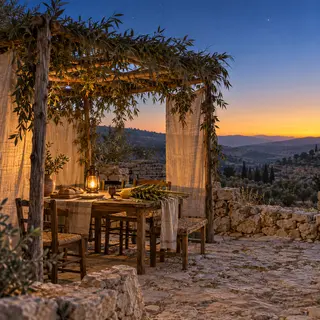
This year Sukkot entered together with Shabbat. Before we had quite settled back behind the walls of home after Yom Kippur, the Torah sent us outside—to walls through which the street can still be heard and to a leafy roof that does not entirely hide the sky.
We leave a house that appears permanent and enter a temporary sukkah. Is the Holy One asking us to feel less secure—or to rediscover where our security truly dwells?
This is not an ordinary weekly parasha in the annual cycle. The festival reading moves through the appointed times of the LORD and arrives at Sukkot, the season of ingathering and the season of our joy. Precisely when the threshing floor and winepress are full, when we might look at the harvest and say, “My own hand achieved this,” Israel is commanded to leave the appearance of permanence for seven days and remember who brought us out of Egypt and carried us through the wilderness.
“You shall dwell in temporary shelters for seven days … that your generations may know that I made the children of Israel dwell in temporary shelters when I brought them out of the land of Egypt.”
Leviticus 23:42–43
Dwelling in order to remember
The Torah does not tell us only to think about the sukkah, but to dwell in it. Biblical remembrance enters the body: we eat, welcome guests, breathe the night air, and feel that the roof above us is not absolute. The sukkah does not glorify deprivation, nor does it ask us to call danger good. It teaches gently that even the strongest house cannot be our God.
The same commandment holds joy: “You shall rejoice before the LORD your God seven days.” This is not joy because everything is in our hands, but joy before him. We remember the wilderness not to remain in fear, but to recognize again the One who provided, protected, led, and dwelt among his people.
What temporary thing in our lives has been asked to carry a weight that only the Holy One can bear?
Moshe’s prayer inside the sukkah
Psalm 90 is not one of the fixed festival readings, yet this year it gives exact words to our sitting in the sukkah. It is titled “A prayer of Moshe, the man of God.” Moshe, who lived among a whole people in tents and spent years without a permanent address, begins with a startling confession:
“Lord, you have been our dwelling place for all generations. Before the mountains were born … even from everlasting to everlasting, you are God.”
Psalm 90:1–2
Moshe does not say only that the Holy One gives us a dwelling. He says, you have been our dwelling. Before the Tabernacle, before the Temple, and before a house built of stone, he himself was home to his people. The temporary sukkah thus becomes a lesson about what is not temporary: mountains are born and generations pass, but he is God from everlasting to everlasting.
The psalm does not beautify the brevity of life. Human beings are like grass that sprouts in the morning and withers by evening. Our years pass quickly, so Moshe asks, “Teach us to count our days, that we may gain a heart of wisdom.” Numbering our days is not meant to make us more anxious, but more wise—to know what is not eternal and give our heart to what is.
Then the prayer moves from transience toward two precious Hebrew words: chesed and noam. “Satisfy us in the morning with your lovingkindness”—our achievements cannot satisfy the deepest hunger. Near the end Moshe prays, “Let the noam of the Lord our God be upon us.” Noam carries the sense of beauty, graciousness, and favor resting upon a life. Moshe does not ask that the work of our hands become eternal by its own strength; he asks the eternal God to establish it.
Life is brief like the grass of morning.
The Holy One is our dwelling through every generation.
His chesed satisfies us within what is temporary.
His noam gives enduring weight to the work of our hands.
Jerusalem, the King, and the nations
The Haftarah does not flee from rupture. Zechariah sees Jerusalem surrounded by war and the Holy One going out to fight for the city. Yet the vision moves from siege to living waters, from threat to kingship, and from nations coming against Jerusalem to nations going up to worship the King.
“The LORD will be King over all the earth. In that day the LORD will be one, and his name one.”
Zechariah 14:9
At the end of the chapter, survivors from among the nations go up year after year to worship the King and keep Sukkot. They do not replace Israel, and they do not move the center of the story elsewhere. They come to Jerusalem and join the worship of Israel’s God. In this way the promise to Avraham—that the families of the earth would be blessed through him—widens without erasing the family through whom the blessing came.
When the Shekhinah draws near
It is worth staying for a moment with the images Torah has already given us: God bringing out his people, causing them to dwell in booths, and dwelling among them; Moshe’s prayer that the Holy One himself is our home; and a prophet who sees living waters flowing from Jerusalem and the nations coming to the King. Within those images a question begins to arise gently: how will the Holy One bring his Shekhinah near, and how will he open his dwelling to the nations without breaking his covenant with Israel?
Yochanan describes Yeshua in language that returns us to the Mishkan: “The Word became flesh and dwelt among us. We saw his glory.” We need not turn this into a claim about the date of Yeshua’s birth; the text does not say that he was born at Sukkot. The connection is deeper than calendar speculation: in Messiah Yeshua, I believe, the presence of the Holy One does not remain a distant idea. It draws near and dwells among us. John 1:14
Yochanan later places Yeshua in Jerusalem during Sukkot itself. On the last day of the festival he calls the thirsty to come to him and drink, speaking of rivers of living water flowing from within. Jewish tradition remembers the rejoicing at the place of water drawing during the festival; and Zechariah, today’s Haftarah, already sees living waters flowing from Jerusalem. Yeshua does not uproot the symbol from Sukkot. He stands within it and invites us to ask whether in him the source of life is drawing near. John 7:37–39
The sukkah tells us that our walls are temporary; Yeshua reveals that the presence of the Holy One can dwell with human beings. In him the chesed of Israel’s God takes on a face near to us, and his noam rests on work that would otherwise pass away.
Revelation carries the hope to its completion: “Behold, God’s dwelling is with people.” This is not the cancellation of Israel’s story, but its fruit: Israel’s God dwells with humanity, the King reigns, and the nations walk in his light. What the sukkah teaches for one week becomes a hope for the age to come—not that we build a house large enough for God, but that he chooses to dwell with us. Revelation 21:3, 22–24
Entering the sukkah without escaping life
Sukkot does not ask us to despise home, work, or plans. Psalm 90 even asks twice, “Establish the work of our hands.” But it puts our loves in order. A home is a gift, not a god. Work matters, but it cannot justify our existence. Our years are precious precisely because they are not endless.
We can sit in the sukkah and ask simply: What am I trying to hold as if it could never pass away? Where do I need the Holy One’s chesed this morning? Upon what small work of my hands am I asking his noam to rest—a reconciling conversation, a table opened to a guest, help for someone in need, or a faithful step no one else yet sees?
If the Holy One himself is our dwelling, what can we hold with a more open hand today?
Reflect and discover
Questions for reflection
- Why does Torah join the joy of Sukkot to the memory of the wilderness?
- What changes when Moshe says that the Holy One himself is our dwelling?
- How do chesed and noam answer the brevity of life in Psalm 90?
- What does Zechariah teach about Israel, Jerusalem, and the nations in the future hope?
- What work of your hands would you like to ask the Holy One to establish this week?
Prayer
Our Father in heaven
You have been our dwelling from generation to generation. Teach us to number our days without fear and to gain a heart of wisdom. Satisfy us in the morning with your chesed, and teach us to rejoice before you even within what is temporary. Spread your peace over the sukkah of your people Israel, guard Jerusalem, and teach the nations to come to you in humility rather than pride. Let your noam be upon us, and establish the work of our hands. Draw us near to your Shekhinah, and open our eyes to see in Messiah Yeshua your chesed drawing near and dwelling with us. In the name of Messiah Yeshua. May his merit protect us and all Israel. Amen.
Shabbat shalom and chag Sukkot sameach
Scripture excerpts are translated from this site’s Hebrew text. Full-reading links open the Complete Jewish Bible, which follows Hebrew verse numbering.