
Parashat Toldot begins with familiar words: “These are the generations of Isaac, son of Abraham; Abraham fathered Isaac.” Yet instead of a peaceful story about the family continuing, we enter a home filled with struggle. Isaac and Rebekah wait twenty years for children. When the pregnancy finally comes, the sons are already struggling within her. Later they struggle over birthright, blessing, and identity until one flees the home and the other plans to kill him.
The birthright is sold for stew, the blessing is taken in disguise, and Abraham’s wells are filled with earth. Can God’s promise pass through a family this broken? And who is the Son who will neither despise the inheritance, steal a blessing, nor surrender to the hunger of the moment, but open a well of living water again?
Two sons, before either had done anything
Before the birth, before the stew, and before the deception, Rebekah goes “to inquire of Adonai.” The pain within her is more than physical; it becomes a question: “If so, why am I?” God’s answer reveals that the private struggle concerns the future of two peoples: “Two nations are in your womb...and the older will serve the younger.”
Jacob is chosen before either brother has proved himself. Election is not a reward for good behavior, and it certainly does not declare that everything Jacob does from now on will be right. The Torah does not hide his deception or spare him its consequences. It teaches something harder: the covenant begins in God’s grace and choosing, while the chosen person still needs deep transformation.
Rashi brings a midrash from Genesis Rabbah that hears in the Hebrew word for “struggled” a running in opposite directions and a conflict over two worlds. This is midrash, not the whole plain meaning of the text, but it catches the tension that follows the portion: what will draw us more strongly, what stands before our eyes now or the inheritance we cannot yet see?
Four actions and one verdict
Esau returns from the field tired and hungry. Jacob is cooking stew, and Esau asks to be fed “some of that red, red stew.” Jacob exploits the moment and demands the birthright. We do not need to make his act look better than it was. Yet the final verse places the weight on Esau’s choice: “He ate and drank, rose and went away; and Esau despised the birthright.”
He ate. He drank. He rose. He went. Four quick actions, and then the narrator’s verdict: he despised the birthright. This is not only the weakness of a hungry man. Esau says it himself: “I am about to die, so what is this birthright to me?” Anything that cannot fill his stomach now appears to have no value.
“He ate and drank, rose and went away; and Esau despised the birthright.”
Genesis 25:34
The birthright is more than a double share of property. In Abraham’s household it is tied to the responsibility of carrying the covenant, keeping God’s way, and passing the blessing to the next generation. Esau wants a blessing but does not value the calling within it. Jacob values the calling but tries to secure it with his own hands. One despises the gift; the other grasps it in a way that wounds the home.
Isaac digs instead of running
In the middle of the brothers’ story, the Torah pauses and gives a chapter to Isaac. Famine comes to the land as it did in Abraham’s day, but Adonai tells him not to go down to Egypt. Isaac remains in the land, plants seed, and reaps a hundredfold. At that very point the Philistines stop Abraham’s wells and fill them with earth.
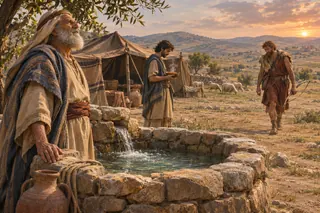
Isaac does not invent a new story for himself. He returns to the wells his father dug and calls them by the same names. This is not nostalgia. He clears away the earth that has gathered over the source of life and discovers that the water is still there. But they quarrel with him over the first well and then the second. He names them Esek and Sitnah: contention and hostility.
Isaac could fight. He is already wealthy and powerful, and Abimelech later admits, “You have become much mightier than we.” Yet Isaac moves on and digs again. When the quarrel ends, he names the well Rehoboth: “Now Adonai has made room for us, and we will be fruitful in the land.” This is not weakness. It is strength that does not need to turn every well into a battlefield in order to know that the promise is true.
Ramban read the three wells as a sign of three Temples: two that would stand amid hostility and be destroyed, and a future house established in spaciousness and peace. This is a bold midrashic reading, not the plain meaning of the verses. Yet it beautifully connects a well of living water with the place where Israel and the nations will come to worship God. Even after obstruction, exile, and destruction, the source has not disappeared. It must be dug open again.
The voice is Jacob’s voice, but the hands are Esau’s hands
Inside the home, the distance between family members grows. “Isaac loved Esau because game was in his mouth, but Rebekah loved Jacob.” Love divides into camps. Rebekah remembers God’s word about the younger son, but instead of speaking with Isaac she builds a plan. Jacob puts on his brother’s garments, covers his hands with skins, and enters his father’s room in a name that is not his own.
The story is chilling because Isaac nearly recognizes the truth: “The voice is Jacob’s voice, but the hands are Esau’s hands.” The voice says one thing; touch and smell say another. Jacob receives the blessing while disguised as someone else, but the cost arrives immediately. Esau cries out, Isaac trembles violently, Jacob flees, and Rebekah does not see him return as she expected.
Does God’s purpose need our deception in order to come to pass? If God had already chosen Jacob, why did Jacob believe he had to wear Esau’s skin to receive what had been promised to him?
The Torah offers no simple answer that clears everyone. Isaac was blind in more than his eyes; Rebekah knew the promise but acted in secret; Jacob wanted the right thing by a crooked path; and Esau wept over the blessing after despising the birthright. This is a home of real people, not a display case of flawless heroes. God remains faithful even while his chosen people are still learning to walk in truth.
Blessing is not merely a kind word
Everyone in the household treats the blessing as though something real is about to pass from Isaac’s mouth to the person standing before him. Jacob is afraid: “I would bring a curse upon myself and not a blessing.” Rebekah answers, “Let your curse be upon me, my son.” When the deception is exposed, Isaac trembles violently, yet still declares concerning Jacob, “Indeed, he shall be blessed.” And Esau, who had already despised the birthright, cries bitterly, “Bless me, me also, my father.” None of them treats blessing as a compliment that can simply be withdrawn. They all understand that words can carry reality, identity, and a future.
To understand why, we should return to the first place where Torah uses the word “blessing.” God blesses the creatures of the sea and the birds and says, “Be fruitful and multiply.” Then he blesses the man and woman created in his image: “Be fruitful and multiply, and fill the earth.” Blessing first appears as the Creator declaring the purpose for which he made his creatures and giving them life and power to fulfill it. He does not merely wish fruitfulness for them; his word releases in them the capacity to bear fruit and multiply the life and beauty he placed within them.
This is how blessing moves through Scripture: it names the calling God has given and summons it to come forth. Like a seed that falls into the ground in order to bear fruit, blessing is not meant to remain a word sealed inside one moment. It seeks to continue from generation to generation and family to family until the goodness God planted multiplies in the earth.
This does not mean that human words are magic or that every declaration we make binds God. The power is not in a formula but in the God who blesses. Yet when we bless in faith and in agreement with his will, our words can call a person toward their purpose, strengthen identity and courage within them, and invoke God’s favor over them. That is why James warns that the tongue cannot bless the Lord and then curse human beings made in God’s likeness. What leaves our mouths carries weight.
Do we understand the power of blessing, and do we guard what our lips say? God told Abraham, “I will bless you...and be a blessing.” Abraham did not merely receive blessing; he was called to become its channel. Bless your spouse, your children, your friends, and your coworkers. Bless your home, your business, your street, your city, and our people. Do not stop with a compliment: speak truth, call the good God planted in them into the light, and ask him to empower them to become everything he created them to be.
Israel’s Messiah beneath Esau’s garments
Yet the sages heard more in this verse than a family drama. In Midrash Tanchuma, “the voice of Jacob” becomes the voice of the Messianic King, the voice that will finally shake the hands of Esau. Hasidic tradition develops another direction: even when a son of Jacob appears outwardly dressed as Esau, his inward identity has not changed. These sources are not interpretations about Yeshua, and we must not pretend the rabbis said they were. But they give us ancient Jewish language for the question in the text: what happens when the clothing points to Esau while the voice discloses Jacob?
In a Messianic reading, Isaac’s dim eyes also become a painful picture of Israel trying to identify its son. Isaac hears correctly, but lets touch, scent, and clothing overrule what he heard. Something similar has often happened to our people with Yeshua. For generations he was presented to us under a foreign name, in European paintings, through institutions detached from their Jewish roots, and sometimes by rulers who persecuted Jews. No wonder the exterior looked like Esau, Edom, and Rome. Some of that foreign clothing did not come from Yeshua; history put it on him.
Paul is very careful when he describes this mystery: “A partial hardening has come upon Israel until the fullness of the nations has come in.” It is not total blindness, not a final sentence, and certainly not permission for the nations to boast over Israel. Isaac did not cease to be the chosen patriarch when his eyes grew dim; neither has Israel ceased to be the covenant people because of a temporary and partial hardening. The same chapter reminds us that God’s gifts and calling are irrevocable. This is not a picture of a rejected father, but of a father who hears the voice before he is able to recognize the son.
If we set aside for a moment the garments history placed upon him and listen to his voice, whom do we hear?
We hear a Jew from Galilee quoting Torah and the Prophets, declaring the Shema, going up to Jerusalem for the festivals, calling the Temple “my Father’s house,” and saying that salvation is from the Jews. We hear one who did not come to abolish the Torah and the Prophets but to bring them to their fullness. The clothing wrapped around him by the nations may appear foreign; the voice, the substance, the love for the God of Abraham, Isaac, and Jacob, and the longing for his kingdom are the voice of Jacob.
Joseph gives us a similar picture. His brothers stood before him and saw an Egyptian ruler: Egyptian clothing, an Egyptian name, a foreign language, and authority over nations. Joseph recognized them, but they did not recognize him until he removed the distance and said, “I am Joseph your brother.” In the same way Yeshua has come to appear to many of his own people as a figure belonging to the nations. Yet beneath the foreign clothing stands a Jewish brother, Son of David, Messiah of Israel, and Savior of the world. He knows his brothers even while they do not yet recognize him.
David too was first judged by the exterior. Scripture calls him “ruddy, with beautiful eyes.” Yalkut Shimoni says that when Samuel saw David’s redness, he feared David would shed blood like Esau until God pointed to his “beautiful eyes.” David was not an Edomite; he was ruddy, but the appearance evoked Esau. His lineage was also challenged because of Ruth the Moabite, and a later midrashic tradition even says he was suspected of illegitimacy and rejected within his home. The stone that appeared disqualified became the cornerstone, and from David’s house comes the promised King.
Song of Songs announces, “The voice of the turtledove is heard in our land.” Pesikta Rabbati hears in that “voice of the turtledove” the voice of the Messianic King, while the tradition of Kol HaTor also connects it with Messiah son of Joseph. It is not the same verse, but the echo is deliberate: Jacob’s voice, the turtledove’s voice, the voice of the hidden brother. Perhaps Israel’s question is not only how he looks after two thousand years of foreign clothing, but whether we will stop and listen. When his stories and words are read inside their Jewish world, we begin to hear: he belongs to us, and we belong to him.
Who truly carries the blessing?
It is easy to turn Toldot into a contest over ownership: who possesses the true story, who is the principal heir, and who may say, “The blessing belongs to us.” Schools of interpretation, Hasidic courts, religious streams, churches, and even Messianic communities can all compete for first place. But clothing, ancestry, institutions, and the influence of a teacher do not appoint the bearer of the blessing. Before either son had done good or evil, God determined who would carry the line of promise. Election is not a prize for the group that claims to be better than everyone else; it is a calling to carry God’s blessing with humility and faithfulness.
Here a profound prophetic clue opens. In Isaiah 49 God says to the individual servant, “You are my servant, Israel, in whom I will be glorified.” Two verses later that same servant is commissioned to “bring Jacob back to him” and restore Israel. How can the servant be called Israel and also restore Israel? A king can bear within himself the name and calling of his people. In a Messianic reading, Yeshua is faithful Israel—not Israel’s replacement, but Israel’s Son and representative, the one who fulfills Israel’s mission and brings Jacob back to his God. He bears the name of his people in order to heal his people, and through him light also reaches the nations.
Yeshua’s parable of the two sons exposes a similar danger. The younger son asks for his share of the estate while his father is alive—a request that makes the inheritance appear more important to him than the father. The older son remains at home, yet he too effectively says, “All these years I served you, and you never gave me even a young goat.” One leaves and one stays; both measure their relationship with the father by what they received from him. In Isaac’s household too, the brothers struggle over birthright and blessing while their father is still alive. This is not an exact parallel, but it is a piercing echo: we can desire the inheritance, the story, and the blessing while still missing the Father’s heart.
Are we seeking to know the Father and carry his heart, or merely to win the argument over who is the heir? The faithful Son neither steals his portion nor drives his brother away; he brings the children home.
A stolen blessing, and Abraham’s blessing given openly
One detail in the portion rearranges the whole picture. The blessing Jacob receives in disguise concerns the dew of heaven, the richness of the earth, grain, wine, and rule among brothers and nations. But when Isaac knows exactly who stands before him and sends Jacob to Paddan-aram, he blesses him again openly: “May he give you the blessing of Abraham, to you and to your seed with you, that you may possess the land of your sojourning which God gave to Abraham.”
Here there are no skins, borrowed garments, or mistaken identities. Isaac knows this is Jacob, and consciously passes to him the blessing of Abraham: offspring, an assembly of peoples, and the land God gave to Abraham. The promise does not finally rest on the success of the disguise. It is given in the open, even though Jacob must still pass through years of deception, labor, wrestling, and transformation before he learns to receive his new name, Israel.
The Haftarah: the chosen can still despise the gift
Malachi begins with a declaration: “I have loved you, says Adonai.” The people ask, “How have you loved us?” and the answer returns to Jacob and Esau. Jacob’s election is meant to display God’s covenant love for Israel. It is not permission to hate human beings or nations, nor does it claim Jacob was righteous in every act. It is a historical choosing to carry promise and calling.
Then comes the surprise. The prophet is not satisfied that Israel is chosen. He turns to the priests and calls them “despisers of my name.” They bring the blind, lame, and sick to the altar and say, “The table of Adonai is contemptible.” The same word that described Esau’s posture toward the birthright now appears inside Israel’s house: despised, contemptible.
This is the deep connection between Torah and Haftarah. The question is not only who was chosen. The question is what the chosen will do with the choosing. We can receive an inheritance and live as if it has no value. We can serve beside the altar and give God our leftovers. Election is not an ornament of honor; it is a call to love what God loves and give him the heart, not what remains of it.
The letter to the Hebrews also returns to Esau and warns the community of believers that no one should be “godless like Esau, who for one meal sold his birthright.” The warning is not aimed only at those outside the covenant. It calls precisely those who have tasted God’s grace to return to him in faith, put away bitterness, and not exchange a living inheritance for passing relief. Repentance begins when we stop calling what is holy worthless.
The Son who refused the shortcut
Here another Son begins to appear. Yeshua enters the wilderness hungry. The voice testing him offers to turn stones into bread and then to take the kingdoms of the world by a shortcut. Esau surrendered a birthright for food; Jacob put on another identity for a blessing. Yeshua refuses both the stew and the disguise: “Man shall not live by bread alone, but by every word that comes from the mouth of Adonai.”
The hidden one begins to be revealed: Yeshua is the Son of Abraham and the faithful Son of Israel, the beloved Son who will not sell his calling to quiet hunger and will not seize a kingdom through deception. He accepts the long road of obedience, service, and suffering. He does not take a blessing from his brother; he gives himself so that people who can neither buy a birthright nor earn a blessing may enter God’s family by grace.
The picture of the wells also opens in him. Yeshua stands in Jerusalem and calls, “If anyone thirsts, let him come to me and drink.” He does not offer water floating above Israel’s story, but the Spirit of God promised by the prophets. The source stopped by the earth of sin, fear, and empty tradition can be opened again. Living water can rise in the heart and turn it from a place of Esek and Sitnah into Rehoboth.
Yeshua does not erase Jacob’s election. The apostolic writings say that God’s gifts and calling for Israel cannot be revoked. Paul returns to God’s word to Rebekah to show that election rests on the One who calls, not on merits the brothers had accumulated. At the same time, through Israel’s Messiah the blessing of Abraham opens to all the families of the earth. Not the nations in place of Israel, and not Israel without a calling to the nations, but God faithful to his promise and bringing mercy to many.
Leaving someone else’s garments behind
The inward redemption of this portion reaches the place where our voice and our hands do not tell the same story. Jacob enters his father’s room with his own voice but his brother’s garments. We too can speak the language of faith while wearing an identity built out of fear, comparison, or an attempt to seize what we fear we will not receive in love.
In Yeshua there is no need to steal a name, a place, or a blessing. We can leave the disguise and allow light to reach the truth. The Spirit of God does not merely promise a future; he digs now through the earth that closed the heart, restores value to what we despised, and teaches us to prefer an eternal inheritance over relief for one moment.
Yet our hope does not remain inward. We still await the day when the faithful Son returns, Israel sees the fullness of God’s covenant faithfulness, the nations come to worship the God of Israel, and the quarrel over the well gives way to Rehoboth. Then the blessing will no longer be something fought over in a dark tent, but life flowing openly from the King to all creation.
Esau despised the birthright because present hunger seemed more real than the promise.
Jacob wanted the blessing but tried to receive it while dressed in his brother’s identity.
Israel has often seen Esau’s clothing around Yeshua; the voice reveals its Jewish brother and Messiah.
Yeshua, the faithful Son, refused the shortcut and opens living water to Israel and the nations.
Toldot does not tell us that God entrusted his promise to a perfect family. It tells us that God remains faithful amid hunger, favoritism, deception, and hostility, and does not give up on transforming his sons. He does not call us to despise the inheritance like Esau or steal it like Jacob in disguise. He invites us not to judge only by clothing, scent, and reputation, but to listen to the voice. In Yeshua he lets us receive by grace what we could never seize by force, recognize our brother and Messiah anew, and dig until living water rises.
Think and discover
Questions for reflection
- How does Jacob’s desire for blessing differ from Esau’s attitude toward the birthright?
- Why did Isaac trust touch and scent more than the voice he recognized?
- What does Isaac teach by digging again instead of fighting over every well?
- Why is Abraham’s blessing given to Jacob openly after the disguise is exposed?
- How does the word “despise” connect Esau with Malachi’s warning to the priests?
- What “garments of Esau” have been placed around Yeshua, and what do we hear when we listen to his words?
A small step for this week
Open one stopped well
Read Genesis 26:18–25 slowly. Think of one thing God already gave you that has gradually been covered with earth: prayer, truth, reconciliation, hesed, or courage to obey. Choose one small action that begins opening the well again. Do not fight over every well today; dig faithfully where God is showing you.
God of Abraham, Isaac, and Jacob, thank you that your love does not rest on our perfection. Forgive us when we despise your gifts or try to seize by force what you desire to give by grace. Remove identities that are not true, open the wells stopped within us, and reveal Yeshua, the faithful Son and Bread of Life. Guard your people Israel, carry Abraham’s blessing to the nations, and lead us into the broad place where your name will be great in all the earth. Amen.
Scripture excerpts are translated from this site’s Hebrew text. Full-reading links open the Complete Jewish Bible, which follows Hebrew verse numbering.