
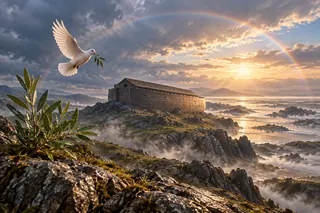
Imagine the moment Noach removes the covering of the ark. After months of water, noise, and waiting, the ground begins to appear. One family stands at the doorway, and the whole world looks as though it has received a new beginning. We can almost hear the words of Genesis 1 again: land and water, birds and animals, and the blessing to be fruitful and multiply.
Yet at this very moment the Torah says something surprising. Before the flood, “every imagination of the thoughts of his heart was only evil continually.” After the flood, the Holy One says, “The imagination of the human heart is evil from youth.” The waters washed the earth, but humanity’s deepest problem came out of the ark with humanity.
If even a flood cannot change the human heart, what kind of redemption do we truly need? Parashat Noach tells of judgment, rescue, and covenant, but between the lines it also awakens a longing for someone who can do more than begin the world again—someone who can begin humanity again.
When seeing becomes taking
Parashat Bereshit ended in a world where evil was no longer a private stumble. The whole earth was “corrupt” and “filled with violence.” The Hebrew word chamas includes violence, injustice, and robbery. People use power to take for themselves, and the place the Creator intended for life fills with fear.
Immediately before this description, a brief and mysterious story appears. The “sons of God” see the daughters of humanity “that they were good” and take wives from whomever they choose. It is difficult not to hear an echo from the garden: the woman saw that the tree was good, and then she took. Again the eye decides what is good, again the hand takes, and again the boundary given by the Creator is pushed aside.
Even the Nephilim and mighty men do not receive the final word. The text repeatedly says that the waters “prevailed”—using the same Hebrew root associated with strength. We need not turn this verbal similarity into a hidden proof to feel the irony: the men of name and might disappear, while the Creator’s word stands. No human or spiritual rebellion can cancel his purpose.
One man who found grace and walked with God
In the middle of this generation the Torah pauses over one person: “Noach was a righteous man, blameless in his generations. Noach walked with God.” The sages disagreed over whether “in his generations” magnifies his righteousness or limits the praise. But Scripture has already said something that comes before all his deeds: “Noach found grace in the eyes of the LORD.” Noach does not invent a way of escape. The Holy One approaches him, reveals what is coming, gives him measurements and a pattern, and establishes his covenant with him.
Noach’s trust takes visible form. He builds an ark while the earth is still dry, gathers food for the animals, and enters when the Holy One calls. Twice the Torah repeats the simple statement: “Noach did all that God commanded him.” Faith here is not a general feeling that everything will work out. It is walking with God before the rain can be seen.
What do we do when God’s word appears true, but there is still no sign on the horizon to confirm it?
When creation returns to the deep
The flood account is written almost like creation moving in reverse. In Genesis 1 the Holy One separated the waters above the expanse from the waters below it. Now the windows of heaven and the fountains of the deep open together, and those boundaries close. Dry land vanishes. Creation returns to the waters from which it had been separated.
Then, at the center of the story, quiet words appear: “God remembered Noach.” This does not mean the Holy One had forgotten and suddenly recalled him. In biblical language, divine remembrance is a turning to act in covenant faithfulness. God sends a wind over the earth, the waters subside, the dry ground appears, and the dove returns with an olive leaf. Creation begins to breathe again.
When Noach comes out, he builds an altar. The first human response in the renewed world is not to build himself a house, but to give thanks. Then the Holy One commits himself to preserve creation’s rhythms: seedtime and harvest, cold and heat, summer and winter, day and night. The future does not rest on the assumption that humanity has become innocent. God knows exactly what remains in the human heart, yet he gives the world a future.
The rainbow: a weapon hung in the cloud
The covenant with Noach is remarkably wide. It is given to Noach, his descendants, every living creature, and the earth. Its sign is the bow in the cloud. The same Hebrew word, keshet, also means a bow used in war. It is as though the weapon has been hung in the heavens, its arc facing away from the earth. This is a beautiful midrashic image, not the verse’s explicit explanation, yet it grasps something deep: God places within the cloud a sign that judgment is not the whole of his desire for the world.
“The bow will be in the cloud. I will see it, to remember the everlasting covenant between God and every living creature.”
Genesis 9:16
The rainbow does not say that there is no judgment, and it does not deny the severity of violence. It says that mercy surrounds the world even after evil has been exposed. This is not humanity’s promise to God. It is the promise God freely gives to a world unable to guarantee its own future.
A new world, the old heart
Noach leaves the ark almost like a new Adam. He receives the blessing to be fruitful and multiply, plants a vineyard, and begins to work the ground. But the story does not leave us with a ceremonial picture. Noach drinks, becomes drunk, and lies exposed in his tent. Shame, violation, and curse appear again within the family that survived.
This is one of the parasha’s painful truths: the entire environment can change while the old humanity is still carried within. Noach was kept through the flood, but he is not the redeemer for whom Lamech hoped when he named him and said, “This one will comfort us.” He brings a measure of rest to the ground, but he does not heal the heart or remove the curse.
The flood teaches us not to minimize evil. The covenant teaches us not to minimize grace. And what is said of the heart after the flood teaches us that an outward new beginning is not enough.
Babel: bricks, a name, and the fear of scattering
Several generations pass, and humanity gathers again. Unity sounds like a good thing, but we must ask what it is built around. The people of Babel say, “Come, let us build ourselves a city and a tower with its top in the heavens, and let us make ourselves a name, lest we be scattered.” They want security without dependence on the Creator, a name they can manufacture, and a concentration of power that will keep them from filling the earth as God commanded.
The Torah is not frightened by brick-making technology. It exposes the heart using it. The world before the flood was one in which each person took what they desired; Babel is a world in which an entire society unites around one desire to make a name for itself. Private power and public power can grow from the same root: humanity wants to determine for itself what is good, what is safe, and who deserves glory.
The Holy One comes down, confuses their language, and scatters them. It is judgment, but also a merciful limit: he stops concentrated power before it turns the whole earth into one project of pride. Yet scattering is not the final answer. The parasha ends with one name almost hidden in a genealogy: Abram.
At Babel they said, “Let us make ourselves a name.” In the next parasha the Holy One will tell Abram, “I will make your name great,” and in him all the families of the earth will be blessed. Is this the new direction—not a name seized for oneself, but a blessing received in order to pass it to every nation?
The Haftarah: “the waters of Noach” and an unshaken covenant of peace
Yeshayahu does not use the flood to frighten Jerusalem, but to comfort her. The barren and abandoned woman is called to enlarge her tent, because the Holy One gathers her with great compassion. Then comes the oath:
“For this is like the waters of Noach to me... so I have sworn not to be angry with you or rebuke you. Though the mountains depart and the hills be removed, my chesed will not depart from you, nor will my covenant of peace be removed.”
Isaiah 54:9–10
The rainbow of Noach becomes, in the prophet’s mouth, a foundation for Israel’s hope. Mountains may move, kingdoms may fall, and Jerusalem may pass through a storm, but the LORD’s chesed and covenant of peace are not cancelled. The Haftarah carries us from the promise to preserve the world to the promise to restore Zion, and from a covenant with all flesh to faithful love for the people the Holy One has not abandoned.
Who can save us not only from the waters, but from the old heart?
Yeshua himself takes his hearers back to the days of Noach. People ate, drank, married, and continued with ordinary life until the flood came. Eating and marriage were not the problem. The problem was a life that ignored the warning and failed to recognize the hour. So, he says, it will be at the coming of the Son of Man. Parashat Noach does not allow us to turn judgment into an ancient story that has nothing to do with us.
Kepha sees the eight people brought safely through water as a pattern of immersion into a greater story. He quickly explains that he does not mean washing dirt from the body, but an appeal to God from a clean conscience, “through the resurrection of Yeshua the Messiah.” The wood of the ark is not magic, and the water itself does not change the heart. Full salvation is bound to the death and resurrection of the Righteous One who bore our wrong and brings us to God.
Here the hidden One begins to come into view. Noach was righteous in his generation and prepared a place of rescue for his family. Yeshua is the Righteous One in whom there is no violence, yet he entered the depth of judgment himself to open the way of life for others. Noach stepped into a world where the heart remained unchanged. Yeshua rose from the dead as the beginning of a new creation and gives the Ruach HaKodesh, so that God’s word may be written not only on tablets or walls, but within the heart.
Lamech hoped that Noach would bring rest from the curse, but that rest remained partial. Yeshua is the one who calls, “Come to me, all who labor and are heavy laden, and I will give you rest.” He does not merely keep us through the storm; he forgives, cleanses the conscience, gives a new heart, and begins within us the new world that water alone could never create.
Redemption begins within, but it does not remain there
It is easy to read about the generation of the flood and think of the violence that is always found in someone else. But the Torah returns to the heart. Public violence often begins in a hidden place: the moment I see another person as an object to take, exploit, dismiss, or silence. Babel begins when the need to feel secure and important becomes greater than the willingness to trust God and bless others.
The inward redemption Yeshua gives is not an escape from the earth. The Ruach HaKodesh changes the source from which our actions flow: from a heart that grasps to a heart that receives grace and can give; from fear that demands control to trust that can walk with God; from the desire to make a name for ourselves to a life that becomes a blessing. In this way covenant reaches the home, our relationships, the way we use power, and the way we see those who differ from us.
Yet we are still waiting for the completion. Kepha recalls the flood when he speaks of the day of judgment and “new heavens and a new earth in which righteousness dwells.” The redemption that began in Yeshua’s resurrection and in the renewed heart will one day embrace all creation. The Holy One will not abandon the earth he made, Israel whom he called by name, or the nations he promised to bless.
The earth is filled with violence, yet Noach finds grace and walks with God.
The waters remove a corrupt world, but they do not change the human heart.
The Holy One makes covenant, preserves creation, and leads the story toward Abraham and Israel.
In Yeshua a way opens toward a new heart and a world where righteousness dwells.
Parashat Noach offers no cheap hope. It looks directly at violence, judgment, and a heart that is not healed by changed circumstances. But it also shows the God who remembers, rescues, makes covenant, and places a rainbow in the cloud. The story moves from the ark to Abraham, from Israel to Messiah, and from the new heart already being formed in us to new heavens and a new earth.
Reflect and discover
Questions for reflection
- What does the repeated description of the human heart before and after the flood teach us?
- What is the difference between being rescued from a difficult situation and receiving a new heart?
- Where are you being called to walk with God before you can see the result?
- Where are you trying to “make a name” instead of receiving blessing in order to pass it on?
- How do the covenant, the Haftarah, and Yeshua’s words deepen the hope beyond judgment?
One small step this week
Open a window and let the light enter
Read Genesis 8:20–9:17 and Isaiah 54:9–10 slowly. Write down where you need more than a change of circumstances—you need renewal of the heart. Ask the Ruach HaKodesh to show you one step of trust, repair, or chesed you can take in the coming days. Then share this question with one person: Why was even the flood not enough to solve humanity’s problem?
God of Abraham, Isaac, and Jacob, you remember your covenant even in the storm. Thank you for the grace Noach found, for the rainbow in the cloud, and for your chesed that does not depart from Zion. Reveal where violence, fear, and pride still work within us. Cleanse us through Yeshua the Messiah, renew us by your Ruach HaKodesh, and teach us to walk with you in faith. Make us people of peace and blessing in this land, and complete the redemption of Israel and the renewal of all creation. Amen.
Scripture excerpts are translated from this site’s Hebrew text. Full-reading links open the Complete Jewish Bible, which follows Hebrew verse numbering.