
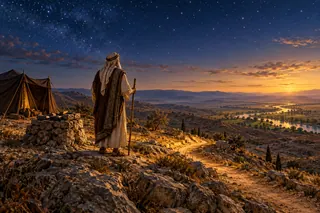
Parashat Noach ended with a scattered world. At Babel, humanity wanted to build itself a city, a tower, and a name so that it would not have to go out into the unknown. Then, almost without introduction, the Holy One turns to one man and tells him to do exactly what Babel feared: Go. Leave your land, your birthplace, and your father’s house, and set out for a land I have not yet shown you.
Abram receives no map. He receives a promise: a people, a land, a name, and a blessing. The people of Babel said, “Let us make ourselves a name.” God says to Abram, “I will make your name great.” This is the difference between a name people build to protect themselves and a name given so that its bearer may become a blessing to others.
Lech Lecha is not the story of a hero who knows where everything will lead. It is the story of a man who hears a voice, takes a step, fails, rises, and continues to lean on a word that has not yet been fulfilled. From this personal journey comes a question that touches the whole Bible: How will God’s blessing travel through Abraham to all the families of the earth?
Going without holding all the answers
“Go forth from your land, from your birthplace, and from your father’s house to the land that I will show you... and be a blessing.”
Genesis 12:1–2
Rashi hears in the words lech lecha also the promise “for your benefit and for your good.” This is a traditional interpretation, not a literal translation of the entire phrase. It matters precisely because the good is not immediately visible. The road passes through dust, famine, tents, and long years in which Abram has no son. The good is not a life without hardship; it is a life gathered into God’s purpose.
The Torah does not polish the father of the nation into a flawless hero. Abram enters the land, builds an altar, and calls on the name of the LORD, but famine comes immediately. He goes down to Egypt, fears he will be killed because of Sarai, and asks her to say she is his sister. The man who left because of a promise now tries to save himself with a plan that endangers his wife. Yet God protects Sarai and brings them back to the land. Abram’s faith is real, but it is still growing. God’s faithfulness is greater even than the moments when human faith contracts in fear.
Does faith mean that we never fear, or that we learn to return to the altar even after fear has led us down the wrong road?
Two ways of seeing the land
Abram and Lot set out together, and both become wealthy. But abundance creates crowding and conflict between their shepherds. Abram, the elder and the one who received the promise, could have chosen first. Instead, he gives Lot the choice. He does not need to seize by force what God has promised him.
Lot lifts his eyes and sees the whole Jordan plain, “well watered everywhere,” like the garden of the LORD and the land of Egypt. He chooses what looks promising now and gradually moves toward Sodom. Only after Lot separates from him does the Holy One tell Abram, “Lift up your eyes and look.” Abram also sees, but his seeing comes after God’s word and is bound to the promise.
Lot chooses land according to what his eyes can promise. Abram receives land according to what God promises, even while his eyes still see a tent and stones. The Torah does not ask us to close our eyes. It asks us who teaches our eyes what is worth choosing.
When Lot is captured in the war of the kings, Abram does not say, “This is the result of his choice.” He goes into danger and rescues him. Trust in the promise does not make Abram indifferent to someone who chose differently. On the contrary, the person who does not constantly have to defend his own portion is free to risk comfort in order to save another.
A mysterious king, bread, and blessing
On the way back from battle, a brief and surprising figure appears: Melchizedek, king of Salem and priest of God Most High. He brings out bread and wine, blesses Abram, and blesses God who delivered Abram’s enemies into his hand. Abram gives him a tenth, but refuses to take the king of Sodom’s property for himself. He will not allow the king of Sodom to say, “I made Abram rich.” His blessing will not depend on the system Sodom represents.
The Torah does not explain where Melchizedek came from or how he became a priest. We need not secretly turn him into another person to feel the force of the moment. In a world of kings fighting for control stands a king whose name joins kingship and righteousness, and he directs the victory toward God Most High. Much later Psalm 110 will sing of a lord seated at God’s right hand who is “a priest forever according to the order of Melchizedek.” Who is this king-priest whose reign is unlike Sodom’s?
“What will you give me?”
After victory and public honor, Abram is left with the old absence: he has no son. The word of the LORD comes to him in a vision: “Do not fear, Abram. I am your shield.” His answer is bold and honest: “Lord GOD, what will you give me, since I continue childless?” Biblical faith does not pretend pain is absent. Abram brings the distance between promise and reality to the One who gave the promise.
The Holy One brings him outside and asks him to look toward heaven and count the stars, if he can. “So shall your seed be.” Then comes one of the Torah’s foundational verses:
“He trusted in the LORD, and He reckoned it to him as righteousness.”
Genesis 15:6
Abram is not reckoned righteous because he has already seen every promise fulfilled. He rests on the faithfulness of the One who promises. Rashi explains that the Holy One counted Abram’s trust as merit and righteousness. Before circumcision, before Isaac, and before there is a nation, the relationship begins with trust in God’s word.
A covenant that passes through darkness
At the covenant between the pieces, Abram prepares the divided animals, but as the sun sets a deep sleep, terror, and great darkness fall on him. He hears in advance that his seed will live as strangers in a land not their own, serve, suffer, and afterward come out with great possessions. Even before the Exodus, exile and redemption enter the covenant story.
In the ancient world, passing between divided pieces expressed a solemn commitment. Here Abram does not pass through. A smoking furnace and a flaming torch, signs of God’s presence, pass between the pieces. The covenant rests first of all on the faithfulness of the One who makes it. Abram will be called to walk, obey, and keep the covenant’s sign, but the promise’s future is not held by the strength of his hands alone.
If the Holy One himself takes responsibility for the covenant promise, what happens when people try to bring the promise about in their own way and their own time?
The human shortcut and the God who sees
The years pass, and Sarai remains barren. She gives Hagar to Abram so that she may build a household through her. The Torah does not hide the cost: tension, humiliation, and flight into the wilderness. The attempt to help the promise come true creates a wound inside the home.
But God does not ignore the woman who was harmed. The angel of the LORD meets Hagar in the wilderness, calls her by name, and promises that her seed too will have a future. She calls him El Roi, the God who sees me, and her son is named Ishmael because the LORD heard her affliction. In Genesis 17 the Holy One makes clear that he will establish the covenant with Isaac, who will be born to Sarah; in the same breath he also hears Abraham’s prayer for Ishmael and promises to bless him.
The choice of Isaac is not permission to despise Ishmael, and Ishmael’s blessing does not cancel the covenant with Isaac. The text holds both truths together. God is faithful to the covenant line he chose, and he also sees the one driven into the wilderness and hears his cry.
A new name and a sign in the body
When he is ninety-nine, Abram hears again: “I am El Shaddai; walk before me and be blameless.” He becomes Abraham, father of a multitude of nations; Sarai becomes Sarah, mother of kings and peoples. The change of name is not decoration. Their identity is tied to what God will yet do through them.
Circumcision marks the promise in the body and across generations. This is not a private idea Abraham keeps in his heart, but a covenant that will carry a family and bring forth a real people in history. We cannot speak of the blessing of the nations as though Israel became unnecessary. The blessing comes to the nations through Abraham’s family, not instead of that family.
The Haftarah: Abraham’s seed is not forgotten
Centuries later Israel in exile feels that its way is hidden from the LORD. Isaiah answers that the Creator does not grow weary, that he gives strength to the faint, and that those who wait for him renew their strength. Then he takes the people back to Abraham:
“But you, Israel, my servant, Jacob whom I have chosen, the seed of Abraham my friend... Do not fear, for I am with you.”
Isaiah 41:8–10
The Haftarah does not transfer Israel’s election to another people. It comforts Israel precisely because Israel is Abraham’s seed. The same voice that told Abram, “Do not fear,” tells his seed in exile, “Do not fear.” The road is long, strength fades, and circumstances change, but election and covenant do not disappear.
Who carries the blessing to all the families?
The Hebrew word zera, “seed,” can refer to one person or to many descendants. There is no grammatical code here that erases the collective meaning. Isaiah himself calls Israel “the seed of Abraham.” Yet as the story advances, the promise also comes into focus in one particular person: a son of Abraham, a son of David, a king through whom blessing reaches the nations.
The writings of the emissaries return specifically to the verse “he trusted in the LORD.” Shaul explains that righteousness comes through trust even before circumcision, and that the promise to the seed finds its focus in Messiah. This does not mean Messiah erases Israel. Yeshua enters the story as a son of Abraham from Israel, fulfills Israel’s calling of blessing, and opens a way for the nations to join the blessing of the God of Abraham.
The brief figure of Melchizedek also receives new light. The letter to the Hebrews does not say that Abraham secretly met Yeshua under another name; it sees the king-priest as an early pattern developed by Psalm 110 and fulfilled in Yeshua: a king of righteousness and peace and a priest whose service does not depend on Levi’s priestly line. The one who blesses Abraham becomes an early sign of the greater king-priest who will carry Abraham’s blessing to its fullness.
The hidden One begins to be revealed: Yeshua is the son of Abraham and the promised seed in whom the covenant blessing opens to every nation. He is the king-priest for whom Psalm 110 waited, and the Righteous One who bore our curse so that by faith we might receive Abraham’s blessing and the Spirit of God. He does not call us away from Israel, but through Israel’s Messiah to the God of Abraham, Isaac, and Jacob.
Yeshua said, “Abraham your father rejoiced to see my day; he saw it and was glad.” Abraham did not see every promise fulfilled in his lifetime. He saw from far away, trusted, and walked. Yet within the promise of the land, the seed, and the nations, he already carried hope for a day when God himself would provide what humanity cannot manufacture.
A Lech Lecha that also begins within us
Abraham’s call is a unique event from which a people and covenant were born; it is not a slogan we can paste onto every personal decision. Yet Yeshua still tells people, “Follow me.” He calls us out of the securities that rule us: the need to see everything in advance, the grip on what appears attractive, and the shortcuts by which we try to accomplish in our strength what only God can give.
Inward redemption begins where we stop hiding our own “What will you give me?” and bring it to God. Through faith in Messiah we are received not because we present a perfect version of ourselves, but because we lean on his faithfulness. The Ruach HaKodesh teaches the heart to leave Sodom’s ways, see the one forgotten in the wilderness, pursue peace without surrendering truth, and turn blessing received into blessing passed on.
Yet the journey does not end only in the heart. Abraham lived in a tent and looked for the city God builds. Israel still waits for the fullness of its comfort, and the nations still need healing. When Messiah returns, wandering will lead home: God’s promises to Israel will stand, the nations will walk in his light, and the blessing that began with one man’s call will fill the earth.
Abram is called to go and rest on a promise he cannot yet see.
God makes covenant, promises land and seed, and prepares redemption from exile.
Israel is called Abraham’s seed and is preserved within the covenant to be a blessing.
In Yeshua, the son of Abraham, the blessing opens to the nations and renews hearts even now.
Two men set out on the road. Lot chose what looked full of water; Abraham learned to choose according to God’s word. But the depth of the parasha is not merely “make the right choice.” It is the Holy One who remains faithful when people fear, rush, or fail; the God who sees Hagar, hears Ishmael, preserves Abraham’s seed, and brings Messiah from that line. Our next step therefore does not rest on our strength alone. It rests on the One who spoke, promised, made covenant, and fulfilled.
Reflect and discover
Questions for reflection
- What is the difference between the way Lot sees and chooses and the way Abraham sees?
- What does the descent to Egypt teach about faith, fear, and God’s faithfulness?
- Why does the Torah include Hagar and Ishmael within Abraham’s covenant story?
- How does the Haftarah connect the individual Abraham with Israel his seed?
- What changes when we read the promised blessing in light of Yeshua, the son of Abraham?
- What false security are you being called to leave this week, and what is the next step of trust?
One small step this week
Look again toward the stars
Read Genesis 15:1–6 and Isaiah 41:8–10 slowly. Write one sentence about the distance you are living in now between promise and reality. Do not cover the question. Bring it to God, and choose one step you can take from trust rather than pressure. Then share this question with one person: What can we see only after listening to God’s word?
God of Abraham, Isaac, and Jacob, you call, promise, and remain faithful when the road is long. Free us from the fear that sends us back to Egypt, from the gaze that chooses only what glitters, and from the urge to fulfill your promises in our own strength. Thank you that you see the forgotten and hear those who cry out. Reveal Yeshua to us, the son of Abraham and king of righteousness; renew our hearts by your Ruach HaKodesh and make us a blessing in Israel and among the nations. Strengthen your people, keep your covenant, and lead us to the day when the land is filled with your King’s righteousness and peace. Amen.
Scripture excerpts are translated from this site’s Hebrew text. Full-reading links open the Complete Jewish Bible, which follows Hebrew verse numbering.