
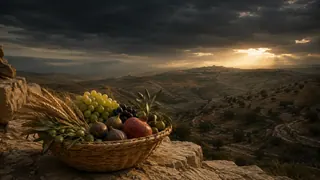
Parashat Ki Tavo meets the people of Israel just before they enter the land. Moshe teaches them how to live there, and one of the first mitzvot in the parasha concerns the first fruits.
A person comes to the place Adonai will choose, carrying a basket with the first produce of the soil. But they do not simply leave the basket and go. They stand before God and tell the story of their people:
“A wandering Aramean was my father… Adonai brought us out of Egypt… and brought us to this place.”
Deuteronomy 26:5–9
There is something beautiful here. The farmer could have said: I worked hard, plowed, and sowed, and here is my fruit. But the Torah teaches the farmer to look at the fruit and remember the story of redemption.
I did not bring myself this far. God heard our cry, brought us out, watched over us, brought us into the land, and gave us all this goodness.
From here, the parasha grows more solemn. Israel hears about blessing and curse, Mount Gerizim and Mount Eival, and the consequences of listening to God or turning away from him.
At the end of the parasha, Moshe says something surprising:
“Yet to this day Adonai has not given you a heart to understand, eyes to see, and ears to hear.”
Deuteronomy 29:3
The people had seen the Exodus, the signs, and the wonders. Yet something deep in the heart was still missing.
Here is a question we cannot hurry past
If, even after all we have seen, we still need a heart that understands, eyes that see, and ears that hear, how can we remain faithful to the covenant? And if we have failed, through whose merit can we pass from curse to blessing?
The idea of b’zchut, “through the merit of,” is familiar in Jewish thought. In Jewish prayer, we often ask for mercy through the merit of our ancestors. When our father Yaakov blesses Ephraim and Menashe, he does not speak of merits they have earned themselves. He says:
“May the angel who has redeemed me from all evil bless the boys.”
Genesis 48:16
Yaakov knows the Redeemer who has watched over him all his life, and asks for that blessing to come upon the boys too.
Then comes the Haftarah for Ki Tavo
“Arise, shine, for your light has come, and the glory of Adonai has risen upon you.”
Isaiah 60:1
Yeshayahu does not describe light arriving when everything is already bright. The next verse says, “For darkness will cover the earth, and thick darkness the peoples.” The light shines precisely within the darkness.
What is this light, and why does it come after so much darkness?
“You will know that I, Adonai, am your Savior and your Redeemer, the Mighty One of Yaakov.”
Isaiah 60:16
If we turn back to the end of the preceding chapter, we read:
“A Redeemer will come to Zion.”
Isaiah 59:20
Then, in the following chapter, an anointed figure says:
“The Spirit of Adonai Elohim is upon me, because Adonai has anointed me to bring good news to the humble.”
Isaiah 61:1
A Redeemer comes to Zion.
Light shines within the darkness.
The anointed one brings good news of redemption, binds up broken hearts, and proclaims freedom to captives.
Who is this Redeemer? Who is the light? And who is the anointed one sent to bring good news, heal, and set people free?
I am among those who believe this sequence points to Yeshua.
In the synagogue, Yeshua read these very words from Isaiah 61 and then said this Scripture was being fulfilled in him. He also said, “I am the light of the world. Whoever follows me will not walk in darkness, but will have the light of life.”
To me, this is also what it means to pray in Yeshua’s name. It is not a magic formula. We come before the Father through the merit of the Redeemer, through what Mashiach has done for us, rather than through merits we think we have earned ourselves.
For those already following Yeshua, the first fruits bring us back to a simple, practical question. What first fruit will we bring to God this week? Perhaps thanksgiving, a step of obedience, forgiveness, reconciliation, helping someone, or sharing what God has done in our lives.
Reflect and discover
Questions for reflection
- What does the parasha reveal to us about God?
- Why does the Torah ask a person to tell the story of redemption when bringing the first fruits?
- What do these passages teach us about our need for a Redeemer?
- What one step could I take this week in response to what I have read?
Prayer
Our Father in heaven
Thank you for being Israel’s Savior and Redeemer. Thank you for not leaving us, even when we failed. Give us a heart to understand, eyes to see, and ears to hear. Help us recognize the Redeemer you sent, walk in your light, and bear good fruit. We come before you through the merit of Mashiach, rather than our own, and in Yeshua’s name. Amen.
Shabbat shalom and blessings
Scripture excerpts are translated from this site’s Hebrew text. Full-reading links open the Complete Jewish Bible, which follows Hebrew verse numbering.