
There is something almost startling about the name of this portion. It is called “The Life of Sarah,” yet its opening words tell of her death: “The life of Sarah was...and Sarah died in Kiriath-arba, that is, Hebron.” The Torah counts the years of her life and then places Abraham before the one thing he cannot repair by negotiation, travel, or effort: the woman who left their homeland with him is gone.
Why is a portion that begins with a grave called “Life”? Why does the Torah devote a whole chapter to the purchase of a field and cave, and then an even longer chapter to finding a wife for Isaac? How do a grave in Hebron, a bride beside a well, and a royal throne in Jerusalem become one story about the faithfulness of God?
At first these look like family matters: burial, marriage, and inheritance. Yet these are precisely the two things God had promised Abraham and which he barely possessed: land and offspring. Sarah dies while Abraham is still a “stranger and resident” in the promised land, and Isaac still has no wife. In the middle of grief, Abraham begins to act for a future he will not see in full.
A burial holding that becomes an act of hope
The Torah does not shorten the Machpelah transaction. It tells us of the Hittites, Ephron, the city gate, the field, the cave, the trees, and four hundred shekels of silver at the accepted weight. Abraham does not accept a vague gift that could later be challenged. He weighs out the full price before the people of the city, and the field is established as his “burial holding.”
This is the strongest contribution in the material supplied this week: Machpelah is not merely a burial place. It is the first piece of land Abraham actually holds in the country God promised to him and his seed. Years earlier he heard near the oaks of Mamre, “All the land that you see I will give to you and to your seed forever.” Now all he owns is a field with a grave in it.
Abraham does not call this gap a failure of the promise. He mourns and weeps for Sarah, and then he rises and acts. His faith does not deny death, nor does it wait passively for God to do everything in his place. It is willing to buy one small plot today because it trusts a greater future.
“I am a stranger and a resident among you. Give me a burial holding among you.”
Genesis 23:4
“Stranger and resident” holds the tension Abraham lives within. He belongs to the promise, yet he does not possess it in fullness. The tombs of the patriarchs and matriarchs carry the same tension. Sarah, Abraham, Isaac, Rebekah, Jacob, and Leah will be buried in the land before their descendants inherit it. The grave becomes a stake of hope: this generation may die, but God does not die, the covenant is not buried, and the land is not forgotten.
Hebron: where promise meets resistance
The supplied material rightly follows Hebron beyond this portion. From here Joseph will be sent to his brothers, beginning the road that brings Jacob’s family to Egypt and eventually to the Exodus. Here the spies will see the sons of Anak and become afraid. Caleb will later ask for Hebron as his inheritance because he followed Adonai fully, and David will be anointed king over Judah here before going up to Jerusalem.
The same place can appear first as a grave, later as a fortress of giants, and later still as the beginning of David’s reign. Scripture therefore teaches us not to measure God’s faithfulness by the present condition of the ground. But neither should every conflict become a mysterious chessboard. The biblical emphasis is simpler and deeper: people are called to act in faith, while the final outcome remains in God’s hands.
Abraham pays. Caleb goes up. David waits for God’s time. None sees the whole promise immediately, but each takes the step given to him. This is how faith enters history: not by leaping over reality, but through faithfulness inside a reality that is not yet complete.
Finding a bride for the promised son
Once a place in the land is secured, Abraham turns to the future of the seed. He makes his servant swear not to take a wife for Isaac from the daughters of Canaan and not to return Isaac to the country Abraham left. Isaac must remain in the promised land, and the woman who will build a home with him must join him willingly.
The Torah does not name the servant here. Tradition identifies him as Eliezer of Damascus, but the story itself leaves him in the background so that his mission stands out. He comes to gain nothing for himself. He carries the father’s word, speaks of the son who has received all the father owns, and seeks to bring a bride to him.
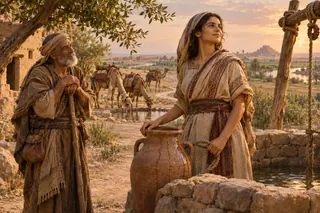
At the well he does not ask for a sign of power or beauty. He asks to recognize hesed. The young woman who gives water to a stranger and of her own accord offers to water his camels will be suited to Abraham’s household. Before he finishes speaking, Rebekah comes out with her jar on her shoulder. She hurries, lowers the jar, draws again and again, and does far more than she was asked.
This is not the magic of a chance meeting. It is hesed meeting providence. The servant prays, watches in silence, and then bows to bless Adonai, who has not abandoned his covenant love and truth. Where Abraham and Sarah can no longer control the future, God is already preparing the woman who will carry the covenant into the next generation.
“I will go”: the answer no one else can give
Rebekah’s family asks to keep her for a few more days. The servant asks to leave at once. Then, in a world where family arrangements were often made over a woman’s head, the text stops and asks her: “Will you go with this man?” Her answer is one word: “I will go.”
Rebekah has not yet seen Isaac. She has the testimony of a servant, gifts, and a promise concerning a family she does not know. What moves her to leave the familiar and go to the promised son?
Her “I will go” echoes Abraham’s lech lecha. She too leaves her father’s house and familiar land for a future resting on God’s word. Yet no one can say this word for her. A covenant can pass from generation to generation, a messenger can explain, and a family can bless; in the end a personal answer is still required.
The tent becomes a home again
At the end of the journey Isaac goes out to meditate in the field toward evening. Rebekah sees him, comes down from the camel, and covers herself with a veil. The servant tells Isaac all he has done, and then comes one of the Torah’s tenderest sentences: “Isaac brought her into the tent of Sarah his mother...and he loved her; and Isaac was comforted after his mother.”
Rebekah does not replace Sarah as though no loss occurred. She enters the tent and continues the household grief had left empty. Rashi brings a midrash that in Sarah’s days a lamp burned from one Shabbat eve to the next, blessing rested on the dough, and a cloud hung over the tent; when Rebekah came, these signs returned. This is midrash, not an explicit detail in the verses, but it catches a beautiful truth in the story: light, bread, and presence return when a new generation receives the calling.
Isaac loves Rebekah and is comforted. The Torah offers no cheap comfort that erases memory. It shows that new life can grow beside pain, and that God’s faithfulness does not leave the tent empty forever.
The Haftarah: who will sit on the promised son’s throne?
The Haftarah takes us to the end of David’s life. Like Abraham, David is old and advanced in days; and as in Abraham’s house, the future turns on the son who will receive what comes next. Adonijah declares, “I will be king,” and prepares chariots, horsemen, and runners. But Bathsheba and Nathan remind David of his oath: Solomon is the son who will reign and sit on his throne.
The connection is more than two old men arranging an inheritance. Abraham gives Isaac all he has; David must pass the kingdom to the chosen son. Both stories hold a son, a promise, an oath, and a future that is not decided by the first person to shout, “I will be king.” God’s faithfulness passes through a generation willing to guard what he has spoken.
The son, the messenger, and the bride
A Messianic reading can too easily turn every detail into a secret code: Abraham is the father, Isaac the son, the servant the Holy Spirit, and Rebekah the bride. There is a beautiful correspondence here, but we must first allow the story to be what it is: the real continuation of the covenant family from which Israel is born. Rebekah is not a symbol that erases a real woman, and Isaac does not disappear inside an allegory.
Precisely when the plain sense is honored, the Messianic pattern grows deeper. A father sends a servant to seek a bride for his son; the servant does not speak of himself but of the son who has received all the father owns; the bride is called to leave and come freely; and at the end she is brought to the son in the promised land. The Apostolic Writings call Yeshua the Son of Abraham and Son of David, and present him also as the Bridegroom who loves his community and gives himself for her.
The hidden One begins to be revealed: Yeshua is the Son of Abraham who bears the covenant blessing and the Son of David who will sit on the throne. He is the Bridegroom calling a people from Israel and the nations—not in place of Israel, but within the fulfillment of Abraham’s blessing for every family. The Spirit of God does not coerce a bride or draw honor to himself; he testifies of the Son, gives living water, and awakens the answer no one else can give for us: “I will go.”
Yeshua also touches the question with which the portion begins. When the Sadducees questioned him about resurrection, he recalled that God is the God of Abraham, Isaac, and Jacob, and added: “He is not the God of the dead, but of the living.” The patriarchs and matriarchs are buried, but God’s covenant with them is not dead.
Yeshua’s resurrection is the guarantee that the grave is not the end of the story. He rose as the firstfruits of those who sleep and will return as Son of David and Bridegroom. Then more than one grieving heart will be comforted: the dead will rise, creation will be renewed, Jerusalem will be prepared as a bride, and the inheritance God promised will no longer stand under the sign of a grave but under the reign of life.
Chayei Sarah beginning within us
The inward redemption of this portion begins when we stop waiting for perfect conditions. Abraham weeps and then rises. The servant prays and then watches. Rebekah hears and then says, “I will go.” Isaac carries his grief and becomes willing to love again. None controls the whole picture, but each responds faithfully to the light given.
Even now the Bridegroom, hesed, beauty, and living water are not only future promises. In Yeshua they touch us in the present. The Spirit of God can turn a closed heart into one that gives water, fear of movement into a step of trust, and an empty tent into a place of light, bread, and presence. This is not a redemption floating above body and history; it begins within and produces tangible hesed in our hands and feet.
Yet we do not settle for inward change alone. Abraham died still waiting, David died before his kingdom reached its fullness, and we too still groan before graves, war, and injustice. Messianic hope says the promise is not smaller than reality: Yeshua will return, raise the dead, confirm God’s faithfulness to Israel, and bring his blessing to the nations.
Sarah is buried in the land, and Abraham holds the promise even before death.
Rebekah says, “I will go,” and the empty tent becomes a home of light and comfort again.
Solomon is called to receive David’s throne, while the prophets await the Son of David whose kingdom will not end.
In Yeshua, the Son and Bridegroom raised from the dead, the promise opens into resurrection, kingdom, and wedding.
Chayei Sarah is not named “life” because death was unreal. Abraham truly wept, Isaac truly grieved, and the grave truly remained in Hebron. It is named “life” because death did not receive the final word. The covenant continued, the tent shone again, the son received a bride, and the promise of the kingdom was guarded. In Yeshua we see not only life continuing after loss, but the beginning of the world in which the grave itself will open and life will overcome.
Think and discover
Questions for reflection
- Why does the Torah tell the purchase of Machpelah in such detail?
- What does “stranger and resident” teach about life between promise and fulfillment?
- Why is Rebekah’s hesed at the well the fitting sign for Abraham’s household?
- What do you hear in Rebekah’s brief answer, “I will go”?
- How does the Haftarah connect Isaac’s inheritance with the kingdom of the Son of David?
- What changes when the portion is read in the light of Yeshua, the Bridegroom raised from the dead?
One small step this week
Give water and say, “I will go”
Read Genesis 24:10–67 slowly. Notice all Rebekah’s verbs: she hurries, lowers, gives, draws, and goes. Choose one act of hesed this week that does not stop at the minimum you were asked to do. Then write one sentence: What step of trust am I being called to answer with “I will go”?
God of Abraham, Isaac, and Jacob, you are faithful even when we stand before a grave and the promise seems far away. Comfort those who mourn, give us Rebekah’s hesed and courage, and make our homes places of light, bread, and presence. Reveal Yeshua to us, the Son of Abraham and Son of David, the Bridegroom raised from the dead. Renew us by your Spirit, preserve your people Israel, bless the nations, and prepare us for the day when the King returns, the dead rise, and death is no more. Amen.
Scripture excerpts are translated from this site’s Hebrew text. Full-reading links open the Complete Jewish Bible, which follows Hebrew verse numbering.